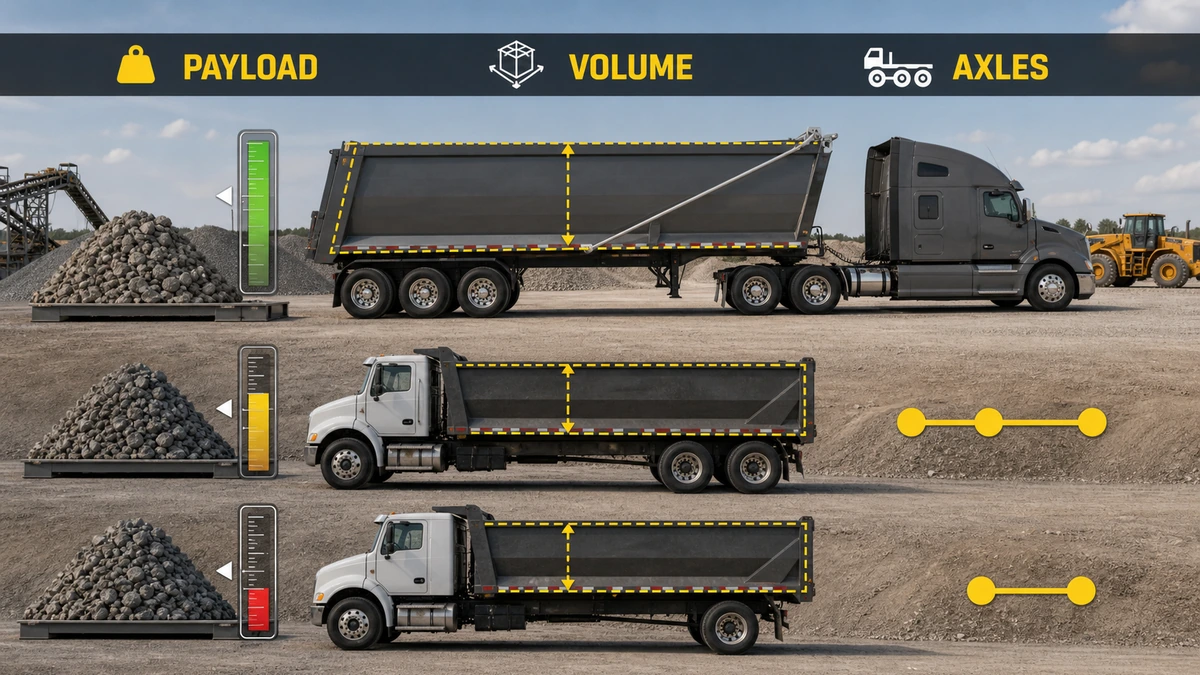
Buyers should compare dump truck capacity by calculating the lowest permitted payload under all relevant constraints: actual tare weight, manufacturer-rated payload, gross vehicle and axle ratings, tire and suspension ratings, local road limits, body volume, material density, route conditions, and operating policy. Axle count alone does not establish legal or productive capacity, and cubic meters cannot be compared without the hauled material.
A larger body can reach the legal mass limit before it is full when hauling dense rock, while a lighter material may fill the body before reaching the allowable payload. A truck that performs well off-road may also be unsuitable for a public-road route with different axle and dimension limits.
Dump Truck Capacity Terms Buyers Must Separate
| Term |
Meaning in an RFQ |
Why it matters |
| Tare/curb weight |
Actual truck weight in the quoted configuration, with defined fuel and equipment condition |
Payload begins after tare |
| GVWR/GVM |
Maximum permitted vehicle mass stated for the vehicle |
One upper constraint |
| Axle ratings |
Permitted load at each axle or axle group |
Poor distribution can limit payload before gross mass |
| Rated payload |
Manufacturer’s stated carrying capacity under defined conditions |
Must be compared with legal and component limits |
| Body volume |
Geometric struck or heaped volume with method stated |
Converts material density into expected mass |
| Legal payload |
Payload permitted on the actual jurisdiction and route |
May be lower than the vehicle rating |
| Productive payload |
Payload used under the fleet’s operating and safety policy |
Drives cycle economics |
1. Obtain the Actual Tare for the Quoted Configuration
Tare changes with:
- Chassis and axle configuration.
- Cab.
- Engine and transmission.
- Fuel tanks.
- Tires.
- Body material and dimensions.
- Hydraulic system.
- Tailgate.
- Liner.
- Spare wheel.
- Tools and optional equipment.
Do not compare brochure tare values if the bodies and options differ. Ask each bidder to state the weighing condition and provide an estimated axle-by-axle tare distribution.
2. Check Gross and Axle Constraints Together
Usable payload is constrained by the first limit reached. At a simplified level:
Allowable payload ≤ permitted gross mass − actual tare
But gross mass alone is not enough. The loaded vehicle must also stay within front- and rear-axle or axle-group limits, tire ratings, suspension ratings, chassis limits, and local law.
The body center of gravity, wheelbase, load distribution, and uneven material loading can cause one axle group to reach its limit early. Request a loaded axle-distribution calculation for the target material and body.
3. Convert Body Volume Into Material Mass
Use:
Payload mass = loaded volume × bulk density
The calculation is only as good as the inputs. State:
- Material.
- Loose bulk density range.
- Moisture range.
- Expected swell or compaction.
- Struck or heaped loading method.
- Maximum lump size.
- Adhesion or carryback.
Use the highest credible density when checking overload risk. For variable quarry material, define the fleet’s load-control method, such as onboard weighing, loader scales, weighbridge control, or fixed bucket counts verified by weight.
4. Compare Axle Configurations by Route and Duty
| Configuration |
Where it may fit |
What to verify |
| Single axle |
Restricted urban sites, lighter duties, or maneuverability-led work |
Legal payload, body size, axle limit, turning space, trip frequency |
| Tandem/6×4 |
General construction and haul work where traction and payload balance are needed |
Driven-axle distribution, route law, gradeability, tire and body match |
| Multi-axle/8×4 |
Higher on-road payload where local axle rules and site access allow |
Turning circle, axle weights, bridge/road limits, body distribution |
| Wide-body mining truck |
Controlled off-road mine or quarry haul roads |
Site rules, ground conditions, gradients, maintenance, loading match |
| Articulated truck |
Rough off-road ground and variable haul roads |
Payload policy, ground pressure, gradients, cycle time, tire support |
This table describes procurement logic, not universal capacity values. Vehicle configuration, regulations, and site conditions must be checked for every project.
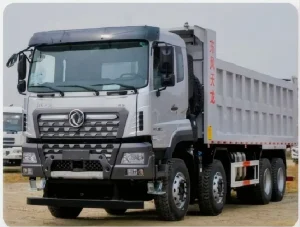
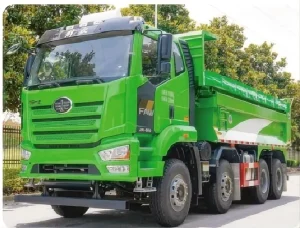
Wentu’s dump-truck range includes FAW Jiefang 6×4, FAW Jiefang 8×4, Dongfeng 8×4, and wide-body mining truck options. Use these as configuration starting points and request the exact offered specification.
5. Include the Haul Route
Send:
- Public road, private road, or mixed operation.
- Country, province/state, and permit regime.
- Bridge and road restrictions.
- Maximum grade and length.
- Surface and seasonal condition.
- Haul distance.
- Loading and dumping area geometry.
- Speed limits.
- Traffic or urban restrictions.
- Altitude and ambient temperature.
For off-road work, describe rolling resistance, mud, loose rock, and maintenance condition. For public roads, the buyer is responsible for verifying registration, dimensions, axle loads, and other local requirements.
6. Compare Productivity, Not Maximum Payload Alone
Daily output depends on:
Productivity = average compliant payload × completed cycles
Cycle time includes loading, travel loaded, queueing, dumping, return, and delays. A larger truck may not improve output if it loads slowly, cannot maneuver, queues at the crusher, or travels below the fleet’s practical speed.
Ask suppliers to discuss:
- Loader pass match.
- Body target volume.
- Tipping time.
- Turning and approach space.
- Grade and traction.
- Fuel and maintenance assumptions.
- Tire availability.
- Spare-parts and service plan.
Treat production estimates as conditional on the route and operating assumptions.
Dump Truck RFQ Checklist
Material and production
- Material:
- Loose bulk density range:
- Moisture:
- Lump size:
- Required tonnes/day:
- Operating hours/day:
- Loading equipment and bucket:
Route
- Public/private/mixed:
- Jurisdiction:
- Distance:
- Maximum grade:
- Surface:
- Seasonal condition:
- Turning and dumping space:
Vehicle
- Required axle configuration:
- Driveline:
- Actual tare basis:
- GVWR/GVM:
- Axle and tire ratings:
- Rated payload:
- Body struck/heaped volume:
- Body material and liner:
- Loaded axle distribution:
Commercial
- Quantity:
- Required documents:
- Homologation/registration responsibility:
- Spare parts:
- Training:
- Destination:
- Schedule:
Confirm the Vehicle and Commercial Scope
Request a configuration-specific quotation showing chassis, axle arrangement, body material and dimensions, tare basis, payload basis, tires, powertrain, braking, tipping system, safety equipment, tools, spare parts, documentation, and after-sales scope. The supplier should state minimum order quantity, available body and equipment customization, destination-market standards or certification evidence to be supplied, inspection terms, export packaging or shipping preparation, lead time after specification approval, and price factors. Compare only vehicles normalized for the same duty, route, legal limits, body scope, warranty, and delivery terms.
Frequently Asked Questions
Does a tri-axle truck always carry more than a tandem-axle truck?
No. Actual capacity depends on tare, gross and axle ratings, local law, body design, tires, and route limits.
Is body volume the same as payload?
No. Volume becomes mass only after applying material bulk density and loading condition.
What is the difference between rated and legal payload?
Rated payload comes from the vehicle specification under defined conditions. Legal payload is what the truck may carry on the actual route after tare, axle, gross, dimension, and jurisdictional limits are applied.
Why request axle-by-axle weights?
One axle group can overload before the truck reaches its gross limit. Axle distribution shows whether the body and material position are suitable.
Which configuration is best for mining?
That depends on whether operation is on-road or off-road, haul-road condition, grades, loading equipment, target output, maintenance, tires, and site rules.
Request a Route-Specific Truck Proposal
Wentu/Juxiang supplies dump trucks, tractor trucks, semi-trailers, special trucks, and construction machinery for overseas projects. Review the dump truck category and send the material density, route, legal limits, production target, desired configuration, body requirements, quantity, destination, and schedule through the contact page.