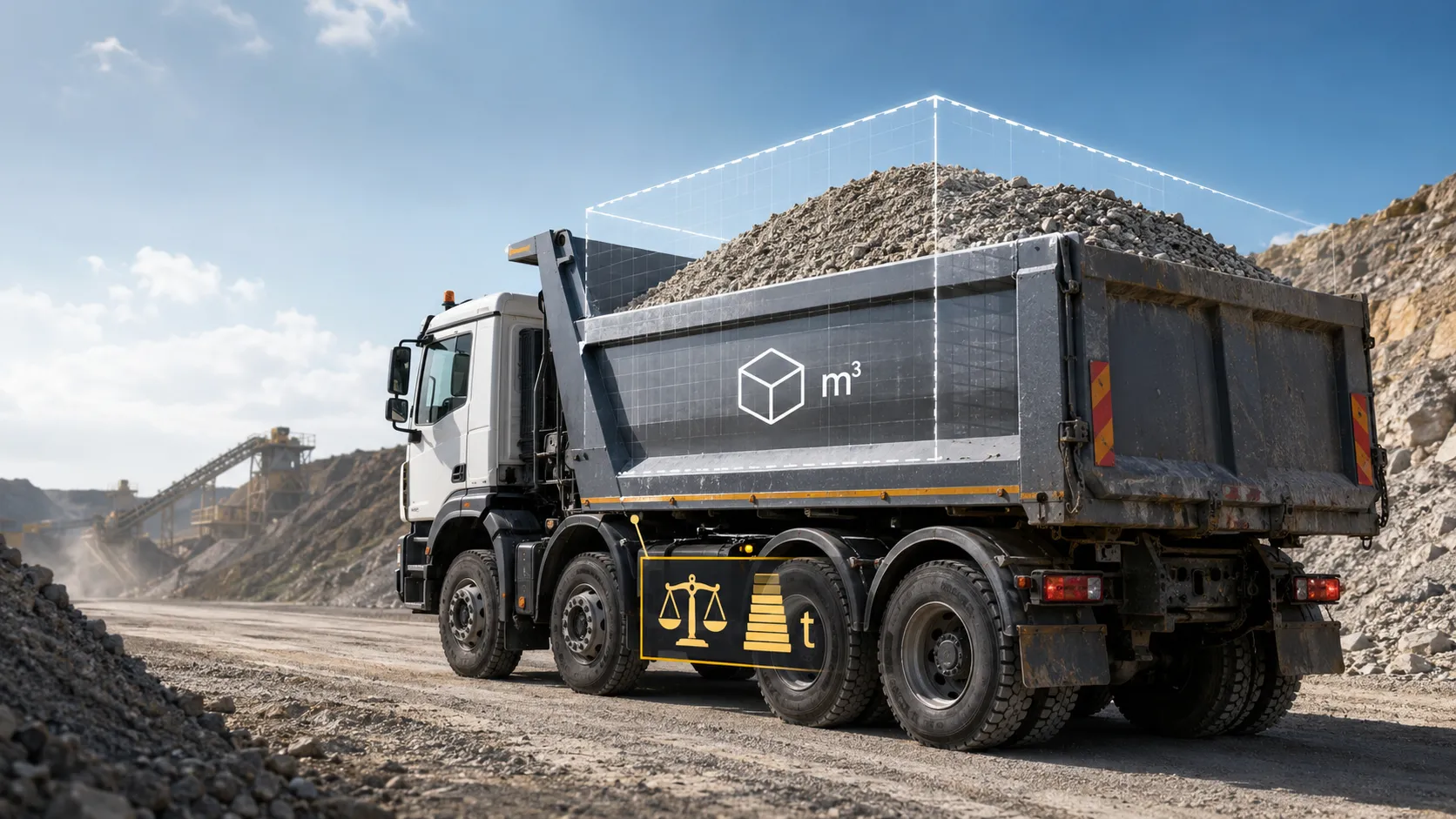
A larger dump truck body does not automatically mean the truck can legally or safely carry more weight. Body volume measures how much space is available for material, while payload measures how much cargo weight the chassis, axles, tires, suspension and braking system are designed to handle. This distinction matters to mining contractors, construction companies, aggregate suppliers, fleet operators and international truck buyers transporting sand, gravel, coal, soil, ore or sludge. Dense material may reach the truck’s weight limit before the body is full, while low-density material may fill the body before the rated payload is reached. The correct truck must therefore match material density, required tonnage, body volume, axle configuration, road conditions and local weight restrictions. This guide explains how to compare those factors and what buyers should include in a dump truck RFQ.
What Is the Difference Between Dump Truck Body Volume and Payload?
Dump truck body volume describes the internal space available inside the cargo body. It is normally expressed in:
- Cubic meters
- Cubic yards
- Liters for smaller bodies
Payload describes the maximum cargo weight the truck is designed or permitted to carry. It is normally expressed in:
- Metric tons
- Kilograms
- Short tons
A truck may have a 20 m³ body, but that does not mean it can safely carry 20 tons, 30 tons or 40 tons of every material.
The relationship depends mainly on material density:
Estimated cargo weight = material density × loaded volume
For example, an 18 m³ load of material with an average bulk density of 1.6 t/m³ would weigh approximately 28.8 tons.
The calculation provides an initial estimate, but buyers must still check:
- Rated chassis payload
- Gross vehicle weight
- Axle load
- Tire capacity
- Body weight
- Optional equipment
- Local road regulations
- Operating terrain
Volvo’s articulated-hauler selection guidance also separates dense materials from light materials: dense gravel and blasted rock may use the standard body, while lower-density coal or fly ash may require body extensions or a light-material body to use the truck’s available payload efficiently.
Why Can the Same Dump Body Carry Different Tonnes of Material?
The same body volume produces different load weights because bulk materials have different densities.
Consider a hypothetical 20 m³ dump body:
| Material condition |
Example density |
Estimated load weight |
| Light bulk material |
0.8 t/m³ |
16 tons |
| Medium-density material |
1.3 t/m³ |
26 tons |
| Dense aggregate |
1.7 t/m³ |
34 tons |
| Very dense material |
2.0 t/m³ |
40 tons |
These figures are illustrative, not universal material specifications. Actual density changes with:
- Moisture content
- Particle size
- Compaction
- Void space
- Contamination
- Source material
- Loading method
Wet sand can weigh significantly more than dry, loose sand. Crushed rock can also change in bulk density according to grading and compaction.
Major equipment manufacturers therefore use both density and body capacity when recommending haul-truck configurations. SANY explains that cargo weight is determined by body volume together with material density, rather than volume alone.
Struck Volume and Heaped Volume Are Not the Same
Dump truck brochures may show two different capacity figures.
Struck volume
Struck volume measures material filled approximately level with the top edges of the dump body.
Heaped volume
Heaped volume includes material piled above the side walls at a specified angle or ratio.
A heaped-volume figure is therefore larger than the struck volume.
Volvo’s A60H specifications, for example, list the standard body separately as 25.8 m³ struck and 33.6 m³ heaped at a 2:1 ratio. This illustrates why buyers must confirm which volume definition a quotation uses.
When comparing dump trucks, ask:
- Is the stated capacity struck or heaped?
- What heaping ratio is used?
- Is a tailgate included?
- Are side extensions included?
- Does the quoted body have a rectangular or U-shaped profile?
- Is the figure a calculated geometric volume or a usable operating volume?
Without these details, two trucks advertised with similar capacities may not offer the same practical loading space.
A Large Body Can Overload the Chassis Before It Is Full
The dump body is only one part of the complete vehicle.
Payload is also limited by:
- Chassis design
- Front and rear axle ratings
- Suspension
- Tires and wheels
- Frame strength
- Engine and transmission
- Braking system
- Vehicle curb weight
- Legal gross weight
A buyer could install a large-volume body on a relatively light chassis, but the truck might reach its maximum safe weight before the body is fully loaded.
SANY similarly notes that dump truck load capacity depends on a combination of body volume, chassis load rating and axle configuration; body width or size alone does not determine payload.
Optional equipment also affects available payload. Liners, side extensions, reinforced tailgates, spare tires, heating systems and other additions increase empty vehicle weight. Volvo specifically states that payload should be reduced by the weight of optional equipment and that gross machine weight must not be exceeded.
How Do 4×2, 6×4 and 8×4 Dump Trucks Differ?
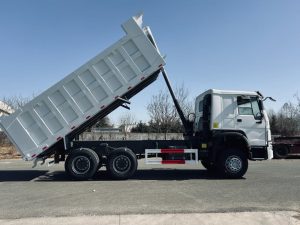
Axle and drive configuration influence payload, traction, maneuverability and road suitability.
4×2 Dump Truck
A 4×2 configuration usually offers:
- Lower vehicle weight
- Smaller turning radius
- Lower initial purchase cost
- Easier operation on paved roads
- Suitability for lighter or moderate loads
Juxiang’s HOWO 4×2 Dump Truck is listed for approximately 12-20-ton applications involving sand, coal, soil and construction transport. Its published cargo-body dimensions are 4200 × 2300 × 1200 mm.
A simple rectangular calculation gives approximately:
4.2 × 2.3 × 1.2 = 11.6 m³
However, the actual usable, struck and heaped volumes should be confirmed because the real body geometry, tailgate and loading profile may alter the result.
A 4×2 truck may suit:
- Urban construction
- Sand and soil delivery
- Short-haul work
- Paved or relatively firm roads
- Sites with limited maneuvering space
6×4 Dump Truck
A 6×4 configuration provides two driven rear axles and is commonly considered for heavier construction, quarry and mining transport.
Juxiang’s HOWO 6×4 Dump Truck is listed with:
- 30-40-ton loading capacity
- Rectangular or U-shaped dump body
- Body dimensions of 5600 × 2500 × 1500 mm
- Multiple engine power options
The simple rectangular body calculation is approximately 21 m³.
This configuration may suit:
- Stone and aggregate transport
- Mine and quarry roads
- Ore transportation
- Construction earthwork
- Short- and medium-distance haul cycles
A 6×4 truck is not automatically the right choice for every 30-ton requirement. The buyer must still evaluate ground conditions, slopes, legal road limits and whether the material will reach the weight limit before filling the body.
8×4 Dump Truck
An 8×4 dump truck adds another axle, which can support higher gross loads and distribute weight across more wheels.
Juxiang’s HOWO 8×4 Dump Truck is listed with:
- 40-50-ton loading capacity
- Body dimensions of 7600 × 2500 × 1500 mm
- Two rear axles
- Multiple engine and horsepower configurations
The simple rectangular body calculation is approximately 28.5 m³.
It may be considered for:
- Large earthmoving projects
- Quarry aggregate transport
- Infrastructure construction
- High-volume bulk-material hauling
- Operations where axle-load distribution matters
An 8×4 vehicle is generally longer and may require more turning and loading space than a smaller configuration.
Buyers can compare additional HOWO, HOHAN, SHACMAN, SITRAK and Dongfeng models through the Dump Truck product category.
When Does Body Volume Matter More Than Payload?
Body volume becomes especially important when transporting low-density materials.
Examples may include:
- Coal
- Fly ash
- Wood chips
- Agricultural material
- Light demolition waste
- Dry, loose soil
- Some municipal waste
A truck may have unused payload capacity after its standard body is full.
In that case, possible solutions include:
- Higher side walls
- Body side extensions
- Light-material body
- Larger but lighter body structure
- Tailgate to reduce spillage
Volvo’s body-selection guide recommends increasing volume for medium- and low-density materials while maintaining the vehicle’s gross weight limit.
However, adding height changes the truck’s:
- Center of gravity
- Loading height
- Tipping stability
- Wind exposure
- Overall dimensions
- Route clearance
A high-volume body should therefore be engineered for the actual chassis and operating environment.
When Does Payload Matter More Than Body Volume?
Payload becomes the main limiting factor when hauling dense material such as:
- Crushed stone
- Dense gravel
- Ore
- Wet sand
- Sludge
- Rock
- Demolition concrete
The body may appear only partly filled when the truck reaches its weight limit.
In these applications, an excessively large body can create several risks:
- Operators may visually assume the truck is underloaded.
- Axles and tires may be overloaded.
- Braking distance may increase.
- Fuel consumption may rise.
- Frame and suspension wear may accelerate.
- The truck may violate local road limits.
- Tipping stability may be reduced.
For dense and abrasive materials, buyers may need a smaller reinforced body rather than the largest possible body.
Body Steel and Liner Weight Also Affect Payload
Dump body durability depends on transported material and loading impact.
Buyers should confirm:
- Bottom plate material
- Side-wall material
- Plate thickness
- Reinforcement layout
- Welding process
- Wear liner
- Tailgate design
- Hydraulic lifting structure
A thick wear liner may extend service life when hauling abrasive rock, but it increases the empty vehicle weight and reduces the remaining payload.
The correct body should balance:
- Wear resistance
- Structural strength
- Empty weight
- Repairability
- Available payload
- Purchase cost
A truck hauling soft soil does not necessarily require the same body plate or reinforcement as a truck loaded with large rocks by an excavator.
Does a Larger Dump Body Improve Productivity?
Not always.
Productivity depends on the entire haul cycle:
- Loader bucket capacity
- Number of loading passes
- Loading time
- Travel distance
- Road gradient
- Site congestion
- Dumping time
- Return speed
- Fuel consumption
- Truck availability
A very large body may require too many loader passes, increasing idle time. A small body may fill quickly but require more trips.
Equipment selection should therefore match the truck with the loading machine.
Volvo’s haul-truck guidance identifies approximately four to six excavator passes as a practical matching range in its articulated-hauler examples, while too few or too many passes can indicate poor machine matching.
For a Wentutrade project, buyers can also review the Construction Machinery category when matching dump trucks with loaders or excavators.
What Should Buyers Include in a Dump Truck RFQ?
A detailed RFQ helps the supplier recommend the correct body and chassis instead of quoting only by cubic meters.
| RFQ item |
Information to provide |
| Material |
Sand, gravel, coal, ore, soil, sludge or waste |
| Bulk density |
Expected minimum and maximum |
| Moisture |
Dry, wet, sticky or variable |
| Required payload |
Target tons per trip |
| Body volume |
Required struck and heaped volume |
| Haul distance |
One-way distance per cycle |
| Road type |
Paved, gravel, mine road or off-road |
| Gradient |
Maximum uphill and downhill slope |
| Axle configuration |
4×2, 6×4, 6×6 or 8×4 |
| Drive requirements |
On-road, off-road or mixed |
| Loader |
Bucket size and loading height |
| Working hours |
Hours and cycles per day |
| Body design |
Rectangle, U-shape, rear tip or custom |
| Body steel |
Required plate and liner specification |
| Power |
Engine and horsepower preference |
| Regulations |
Destination-country axle and weight limits |
| Quantity |
Trial unit or fleet order |
| Destination |
Country and port |
| Documentation |
Inspection, certificates and export documents |
Do not send only:
“I need a 20 m³ dump truck.”
A better request is:
“We transport wet gravel with an estimated density of 1.7 t/m³. Target payload is 32 tons per trip. The route includes an unpaved quarry road with a 12% maximum gradient.”
That information enables the supplier to evaluate both weight and volume.
What Determines the Price of a Dump Truck?
Dump truck pricing depends on:
- Brand and chassis
- 4×2, 6×4, 6×6 or 8×4 configuration
- Engine and horsepower
- Payload class
- Body dimensions
- Steel grade and plate thickness
- Wear liner
- Hydraulic cylinder
- Transmission
- Axle specification
- Tires
- Cabin configuration
- Emission standard
- Custom paint and branding
- Spare parts
- Export documentation
- Order quantity
- Shipping method
A larger body may raise the price, but it may not provide more usable payload for dense materials.
Buyers should compare quotations using one common specification sheet so that body size, payload, chassis, options and documentation are equivalent.
Frequently Asked Questions
Is dump truck capacity measured in tons or cubic meters?
It can be stated in both.
Tons describe payload weight. Cubic meters describe body volume. A complete truck specification should include both.
Does a 20 m³ dump truck carry 20 tons?
Not necessarily.
The cargo weight depends on the material density. Twenty cubic meters of light material may weigh less than 20 tons, while 20 m³ of dense material may exceed the truck’s safe payload.
How can I calculate the material weight in a dump truck?
Multiply the estimated loaded volume by the material’s bulk density:
Cargo weight = volume × density
Then compare the result with the truck’s permitted payload and gross-weight limits.
Which dump truck is suitable for gravel?
The correct model depends on gravel density, required tons per trip, haul-road conditions, slope, trip distance and local axle limits.
Dense gravel often reaches the weight limit before a large body is completely full.
Is a 6×4 or 8×4 dump truck better?
A 6×4 may offer better maneuverability and suit medium-heavy work. An 8×4 can support greater load distribution and larger-capacity applications.
The decision should be based on payload, route, turning space, road restrictions and operating cost.
Why would a coal truck need a larger body?
Coal is generally less dense than rock or gravel. The standard body may become full before the chassis reaches its rated payload, so a light-material body or side extensions may improve utilization.
Can I customize the dump body dimensions?
Wentutrade states that it provides customized truck manufacturing according to specific transport requirements, including vehicle configuration and internal body structure. Final feasibility depends on the chassis, payload, dimensions and destination regulations.
Should I choose the truck with the largest body?
No.
Choose the truck that can transport the required material safely and efficiently without exceeding payload, axle or gross-weight limits.
Match Dump Truck Volume to the Material, Not the Catalog Number
Dump truck selection should begin with the transported material-not with the largest available cargo body.
Before ordering, confirm:
- Material density
- Target payload
- Required struck and heaped volume
- Chassis and axle ratings
- Road and gradient conditions
- Body steel and liner
- Loader bucket matching
- Destination-country weight limits
Send Wentutrade the material type, estimated density, required tons per trip, road conditions, body preference, destination and order quantity.
Contact Juxiang Automotive to receive a dump truck configuration, body-size recommendation and export quotation based on your hauling project.