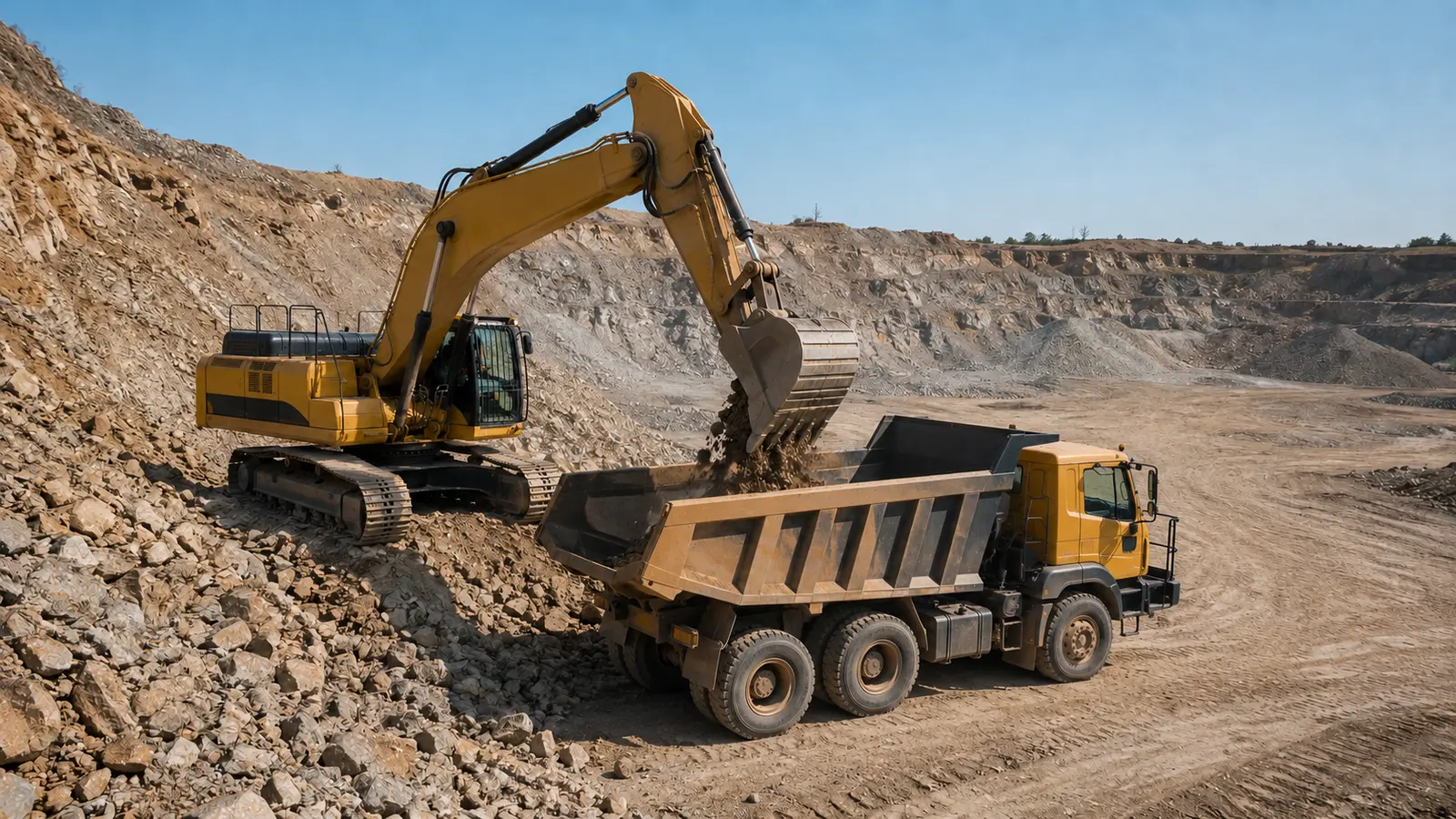
A dump truck and excavator should be selected as one loading-and-hauling system, not as two independent machines. The practical match depends on the material density and fragmentation, excavator bucket and reach, truck-body geometry, legal or site payload limit, target loading passes, haul distance, road condition and the number of trucks assigned to each loading unit. A larger bucket does not automatically create a better system: it may overload the truck, strike the body, create uneven loading or leave the excavator waiting for the next vehicle. A useful RFQ therefore states the material, production target, route, shift pattern, truck payload basis, excavator configuration and required verification evidence before requesting a price.
Why Is Machine Matching a Workflow Decision?
The excavator produces loaded trucks; the trucks remove material and return for another cycle. If either side of that loop is incorrectly sized, the entire system loses output. An excavator that fills a truck quickly may then stand idle while the fleet completes a long haul. Adding trucks can reduce loader waiting, but too many vehicles can create a queue at the face or dumping point. A truck with a large body can also look productive while requiring too many bucket passes, increasing loading time and exposure around the loading zone.
Buyers should therefore define a cycle rather than compare isolated brochure figures. The cycle begins when an empty truck enters the loading position and ends when it returns after travel, unloading and any queuing. Loading time is only one part of this cycle. Route gradients, rolling resistance, turning space, dumping access, traffic control and shift interruptions can all change the number of trucks needed.
For initial product discovery, buyers can review Wentu’s construction machinery range, but a category page cannot determine a working match without project inputs.
Start With the Material and Production Target
The first question is not “Which excavator is largest?” It is “What material must be moved, and how much must the site move during the operating period?” Loose soil, wet clay, blasted rock and mixed demolition material do not load or settle in the same way. Their density affects payload; fragmentation affects bucket fill and loading stability; moisture and adhesion affect clean release from the bucket and body.
State whether the production target is expressed as tonnes per hour, cubic metres per shift or completed loads per day. Volume and mass are not interchangeable. A body may reach its volumetric limit before the truck reaches its allowable payload when moving light material. Dense material may reach the payload limit while much of the body remains visually empty. The RFQ should identify the density basis and say whether it comes from measured site data, a laboratory result or a conservative planning assumption.
Which Variables Should Buyers Compare?
| Decision variable |
Buyer input |
Why it changes the match |
Evidence to request |
| Material |
Type, density, moisture and maximum fragment size |
Controls bucket fill, body use and payload exposure |
Site data and stated design basis |
| Excavator working tool |
Bucket type, nominal volume and expected fill |
Changes mass per pass and loading time |
Offered bucket specification |
| Working geometry |
Reach, dump height, truck side height and loading position |
Insufficient clearance slows work or creates contact risk |
Dimensional drawing or layout review |
| Truck limit |
Permitted payload and body dimensions |
Defines safe load and number of passes |
Vehicle specification and applicable route limit |
| Haul cycle |
One-way distance, speed, grade, surface, dump time and queue |
Determines truck count and idle time |
Cycle assumptions recorded in the quotation |
| Site access |
Road width, turning radius, overhead clearance and ground condition |
Can exclude an otherwise suitable vehicle |
Site plan, route photos and buyer confirmation |
| Operating window |
Hours per shift, shifts per day and availability target |
Converts cycle output into daily production |
Fleet calculation with stated assumptions |
How Should Buyers Calculate the Loading-Pass Match?
Pass matching starts with estimated material mass per bucket, not bucket volume alone. The working estimate is bucket volume multiplied by the expected fill factor and loose material density. That estimate is then compared with the truck’s permitted working payload. The result gives a planning number of passes, but it is not an acceptance certificate: actual fill varies with material, operator technique and bucket geometry.
A practical pass count avoids two extremes. Too few passes can make each bucket a large percentage of the truck limit, increasing the effect of one inconsistent scoop. Too many passes lengthen loading and may indicate that the excavator is small relative to the hauler. Caterpillar’s guidance illustrates why pass match, physical clearance, fill factor and cycle time are considered together rather than through a single capacity figure. The exact target for a Wentu project must still be calculated from the offered machines and the buyer’s material.
For example, a buyer should not divide truck capacity by a bucket’s printed volume and stop. The calculation also needs the payload basis, density, fill assumption and whether the bucket contains level, heaped or irregular material. The supplier should show the assumptions so the buyer can replace planning values with measured site data.
Why Do Reach and Body Geometry Matter?
The excavator must place material into the truck without excessive swing, unstable positioning or contact with the body. Confirm the excavator’s loading radius and dump clearance against the actual truck-body side height and the planned bench or ground level. A dimensional match that works on a flat brochure diagram may fail when the excavator sits below the truck, works from a soft edge or must load over a high reinforced side wall.
Truck spotting also affects cycle time. The machine should have a repeatable approach and departure path that limits reversing conflicts. The excavator should distribute material so axle loading remains controlled rather than creating a concentrated mound at one end. The final arrangement belongs in the site operating plan; the equipment quotation should provide the dimensions required to evaluate it.
How Does Haul Distance Change the Fleet Balance?
Short cycles make loading time a larger share of the total cycle. Long routes make travel time, road condition and dumping delays more influential. If one truck takes twelve minutes to travel, unload and return while the excavator loads a truck in three minutes, a simple starting estimate suggests that several trucks are needed to keep the loader occupied. The real fleet number must also allow for spotting, queues, breaks, refuelling and availability.
More trucks are not always the answer. A narrow loading area may safely hold only one active truck and one waiting unit. The dumping point may be the bottleneck. Road rules may restrict speed or loaded mass. The decision should identify which resource limits output and then size the rest of the system around that constraint.
How Should Buyers Evaluate the Offered Machines?
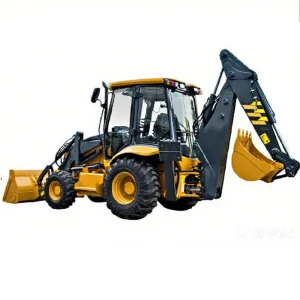
Wentu’s 5-13 LARGE EXCAVATOR product page lists a broad configuration range rather than one fixed machine: engine power of 50–120 kW, loader bucket capacity of 0.5–1.5 m³, rated loader capacity of 1,000–3,000 kg, digging depth of 3,000–6,000 mm and digging force of 30–80 kN. Those ranges establish a product family; they do not mean every value is combined in every configuration. The buyer should request the exact offered model, attachment, dimensions and working data.
The related DONGFENG 6×4 dump-truck page lists an 8,600 × 2,550 × 3,600 mm overall size, a 5,400 × 2,350 × 1,500 mm body, a stated 30–40 tonne capacity range and several horsepower options. These published figures should be treated as quotation inputs to confirm, not permission to assume route legality or site suitability. The controlling load may be lower because of local axle rules, road conditions, registration requirements or the selected final configuration.
What Can Go Wrong When Buyers Match Only by Capacity?
The truck is volumetrically full but below the production plan
Light material fills the body before the assumed tonne target is reached. The consequence is more trips than the buyer expected. Evidence should include both body dimensions and the material-density basis.
The truck reaches its mass limit before looking full
Dense material creates an overload risk even when free volume remains. The loading plan should use mass control, not visual body fill.
The excavator can lift the load but cannot load the body efficiently
Dump height, reach or swing clearance may be inadequate in the real site position. A layout drawing or site trial is more useful than a lifting-force figure alone.
The individual machines work, but the system queues
A correct mechanical match can still produce poor flow if travel, dumping or truck spotting is the bottleneck. The cycle calculation should state every time component and the assumed availability.
What Evidence Should Be Confirmed Before Approval?
The quotation should identify the offered truck and excavator configurations, not only product-family names. Ask for dimension sheets, working-tool details, payload or rated-load definitions, engine and drivetrain configuration, tyre or undercarriage details, service items, included accessories and shipment scope. Where route registration or statutory compliance applies, the buyer should name the destination requirements; the supplier should state what documentation is included and what remains for local confirmation.
A sample test may mean a demonstration, site trial or review of a comparable configuration. Whatever method is used, define the pass criteria: bucket clearance, acceptable pass count, load distribution, cycle-time assumption and evidence format. A video without identified machine configuration and material conditions is useful context but not complete proof.
What Should the RFQ Include?
- Material: type, loose density, moisture and maximum fragment size.
- Production target: tonnes or cubic metres per hour and per shift.
- Loading area: ground level, bench height, turning space and traffic flow.
- Haul route: distance, grade, surface, speed restrictions and road-load rules.
- Dumping process: tipping location, discharge time and queue conditions.
- Excavator requirement: attachment, bucket, reach, dump clearance and required functions.
- Truck requirement: body dimensions, payload basis, drivetrain and tyre requirement.
- Operating plan: shifts, expected availability, fuel and maintenance arrangement.
- Evidence: drawings, configuration sheet, inspection records and destination documents.
- Commercial scope: quantity, destination, delivery terms, spares, training and commissioning boundaries.
Ask the supplier to return each line as Confirmed, Deviation, Alternative or Requires Site Review. This makes different offers easier to compare and exposes assumptions before the purchase order.
Frequently Asked Questions
Should a larger excavator always be paired with a larger dump truck?
No. The match depends on material, geometry, route, production target and working limits. A physically larger pair can be unsuitable for restricted access or may create unnecessary idle capacity.
Can bucket volume be used to calculate truck passes?
It is only one input. Buyers also need fill factor, loose material density, truck payload basis and an allowance for operating variation.
How many trucks should serve one excavator?
There is no universal number. Divide the full truck cycle by loading and spotting time as a starting point, then account for queues, breaks, availability and site limits.
Does a product-page capacity prove legal payload?
No. Product information describes the offered family. Legal and safe working load depends on the exact vehicle, route, destination rules and approved documentation.
Turn the Workflow Into a Comparable Quotation
Send the material, production target, site layout, haul route, shift plan and preferred truck/excavator configuration through Wentu’s project quotation form. Ask for the exact offered specifications, stated calculation assumptions and any deviations before approving the fleet plan or purchase order.