Direct Answer: Fleet buyers should compare dump truck manufacturers by seven verifiable areas: supplier responsibility, chassis configuration, body specification, payload basis, inspection evidence, spare-parts support, and destination documents. A low quotation is not comparable unless every supplier confirms the same truck scope, legal configuration, duty cycle, acceptance method, delivery package, and post-shipment support.
This audit is intended for fleet operators, mining and construction contractors, equipment distributors, logistics companies, government project buyers, and procurement teams sourcing trucks internationally. Before requesting prices, buyers should define the application and review the dump truck product category to identify relevant vehicle families. The shortlist should then be built around evidence, not catalog claims or a single headline payload.
What Are the Seven Audit Gates for Dump Truck Manufacturers?
| Audit Gate | What the Buyer Must Verify | Evidence to Request | Risk if Skipped |
| 1. Supplier responsibility | Who supplies the chassis, builds the body, integrates the hydraulic system, performs inspection, and handles warranty? | Written responsibility matrix, company role, factory or integration scope, and warranty contact route. | Chassis, body, and hydraulic issues are passed between different parties after delivery. |
| 2. Chassis configuration | Exact model, drive arrangement, axle configuration, wheelbase, engine and transmission scope, tire specification, and destination configuration. | Configuration-specific technical sheet and quotation appendix. | The delivered truck differs from the model used during commercial comparison. |
| 3. Body specification | Internal dimensions, nominal volume, material, floor and side design, reinforcement, tailgate, subframe, and tipping arrangement. | Body drawing, material and thickness schedule where available, and intended-material statement. | A large volume is quoted without proving suitability for the hauled material or duty cycle. |
| 4. Payload basis | Curb mass, gross vehicle mass, axle load basis, rated payload, body volume, and destination legal or project limits. | Weight and load breakdown using one consistent definition. | Different suppliers use different payload definitions, making prices appear comparable when they are not. |
| 5. Manufacturing and inspection | Critical welding, body alignment, hydraulic installation, tipping function, leakage checks, safety labels, and final vehicle inspection. | Inspection plan, records, photos, test results, and agreed pre-shipment acceptance points. | Defects are discovered only after arrival, when repair cost and downtime are highest. |
| 6. Spare parts and service | Initial spare package, part identification, manuals, diagnostics, warranty process, and technical response route. | Part-numbered spare list, recommended quantities, support contacts, and warranty procedure. | The fleet receives consumables but cannot identify or obtain critical replacement parts. |
| 7. Export and destination documents | Commercial documents, origin documents, shipping scope, destination approvals, manuals, labels, and any buyer-specified inspection records. | Document checklist tied to the destination and Incoterm. | Vehicles arrive with incomplete documents, incorrect configuration, or unexpected local approval work. |
The first industry lesson is that “manufacturer” can describe different commercial roles. One supplier may produce the chassis, another may fabricate the dump body, and another may integrate, inspect, export, and support the complete vehicle. Buyers should not reject an integrated supplier model, but they must know exactly who is responsible for each system and who will resolve a failure.
Who Is Actually Responsible for the Complete Truck?
A dump truck export project can involve a chassis manufacturer, body builder, hydraulic-system supplier, vehicle integrator, exporter, local dealer, and service partner. The buyer needs one written scope that shows where each responsibility begins and ends.
Ask each shortlisted supplier to identify:
- The chassis brand and exact model proposed
- Who selects and confirms the chassis configuration
- Who manufactures or supplies the dump body
- Who designs or installs the subframe and tipping system
- Who performs final integration and pre-delivery inspection
- Who provides body, hydraulic, chassis, and electrical warranty support
- Who supplies export documents and shipping information
- Who remains the buyer’s technical contact after delivery
A common buyer mistake is accepting a quotation under one company name while warranty responsibility is divided among several parties. The purchase contract should not rely on informal statements such as “the chassis factory will handle it.” Require a responsibility matrix and a single escalation route for the complete supply.
Wentu positions itself as a manufacturing and integrated supply partner using multiple factory resources for dump trucks, trailers, tractor trucks, special trucks, and construction machinery. Buyers reviewing this model can use the Wentu commercial vehicle and equipment supply overview to understand the wider product scope, while still requiring project-specific confirmation of the actual factory, configuration, inspection, and warranty responsibility for each order.
How Should Buyers Normalize Chassis and Body Specifications?
Two dump trucks with the same axle description can still differ in wheelbase, drivetrain, engine and transmission scope, axle ratings, tires, cab, emissions configuration, body size, hydraulic system, and legal suitability. A supplier comparison is valid only when these items are normalized.
| Comparison Item | Minimum RFQ Requirement | Why It Changes the Purchase Decision |
| Chassis identity | Brand, model, production configuration, drive type, axle arrangement, and wheelbase. | Prevents suppliers from quoting different base vehicles under the same general product name. |
| Powertrain scope | Engine, transmission, drive axle, fuel type, emissions configuration, and cooling assumptions. | Changes duty suitability, maintenance, local fuel compatibility, and parts support. |
| Tire and wheel scope | Tire size, pattern, application, quantity, spare-wheel scope, and supply brand if required. | Changes ground performance, replacement availability, operating cost, and delivery value. |
| Body geometry | Internal length, width, height, nominal volume, tailgate type, and loading interface. | Determines whether the body matches the material, loading machine, and route restrictions. |
| Body construction | Material description, floor and side design, reinforcement, subframe, and intended application. | Changes tare mass, wear life, repairability, payload, and total installed cost. |
| Tipping system | Hydraulic arrangement, lifting configuration, operating controls, and inspection requirements. | Changes tipping performance, serviceability, safety, and spare-parts planning. |
The second industry lesson is that model names alone are not a configuration. Export quotations should include a revision-controlled technical appendix. When the buyer changes the destination, emissions requirement, tire, body, or axle arrangement, the supplier should issue an updated configuration instead of editing only the price page.
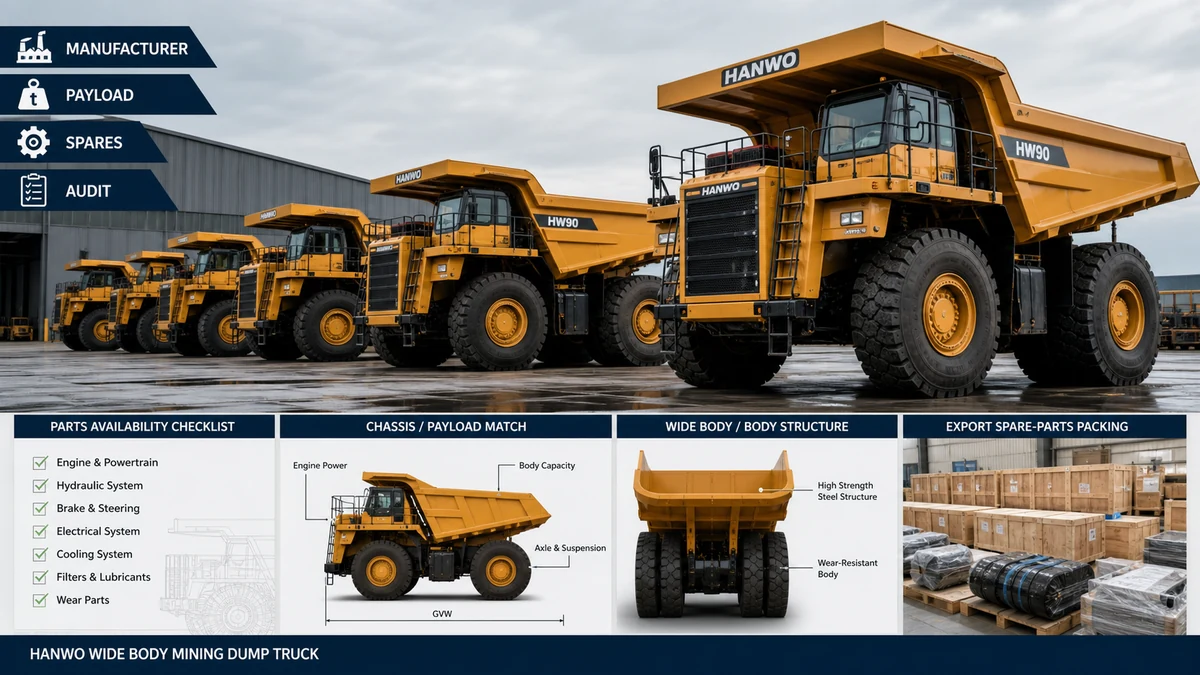
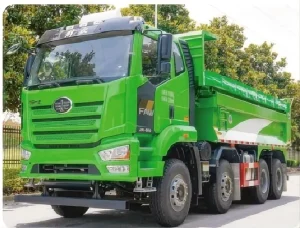
For project comparison, buyers may review a mining-oriented product such as the Hanwo wide-body mining dump truck and a road-going multi-axle option such as the FAW Jiefang 8×4 dump truck. These links confirm that different vehicle families exist within the supply range; they do not replace the need for configuration-specific drawings, weights, duty-cycle confirmation, and destination review.
Why Must Payload Evidence Be Reviewed Before Unit Price?
Payload claims can be based on rated payload, body volume, gross vehicle mass, a site-specific operating value, or a marketing description. Buyers should not compare payload figures until every supplier uses the same definitions.
The RFQ should request:
- Curb mass for the quoted complete vehicle
- Gross vehicle mass or applicable operating mass basis
- Front and rear axle-load assumptions
- Rated payload and the source of that rating
- Nominal body volume and internal body dimensions
- Target material and expected loose bulk density
- Any destination legal, road, bridge, or project load limit
- All optional equipment included in the quoted curb mass
The third industry lesson is that adding a larger body can reduce usable payload when the body itself increases tare mass or encourages overloading with dense material. Price should be compared against a verified configuration and duty, not against the largest body volume printed in a catalog.
Buyers should also separate factory capability from local legality. A truck may be mechanically capable of carrying a load that is not permitted on the destination’s public roads or project infrastructure. The supplier should identify the factory rating, while the buyer or its local compliance partner confirms the destination limit.
What Manufacturing and Inspection Evidence Should Be Agreed?
A factory photo or general quality statement does not prove that the buyer’s exact vehicle was built and inspected to the agreed scope. The order should contain a practical inspection plan covering the chassis identity, body fabrication, hydraulic installation, tipping function, labels, accessories, documents, and final vehicle condition.
Before Production
- Approve the final configuration sheet and body drawing.
- Freeze the chassis model, body dimensions, hydraulic scope, tires, color, labels, accessories, and document list.
- Record all deviations from the original RFQ.
- Confirm which inspections will be documented and which require buyer or third-party attendance.
During Body and Vehicle Integration
- Verify the chassis identity against the approved order.
- Check body dimensions, alignment, reinforcement, subframe, mounting, and visible fabrication condition.
- Inspect hydraulic routing, hose protection, leakage, controls, and lifting operation.
- Confirm that added equipment does not interfere with tires, suspension, drivetrain, cab movement, or service access.
Before Shipment
- Perform a complete-vehicle visual and functional inspection.
- Record body lifting and lowering operation under the agreed safe test condition.
- Check lights, warning devices, labels, supplied tools, manuals, spare parts, and accessories.
- Verify serial information, packing or shipment preparation, shipping dimensions, and document consistency.
- Issue a final exception list and close every open item before shipment release.
The fourth industry lesson is that a single pre-shipment photo set is not an inspection plan. Buyers should define the required views, test records, identification points, acceptance limits, and nonconformance process before production starts. Otherwise, suppliers and buyers may disagree about what “passed inspection” actually means.
How Should Spare Parts and Warranty Be Audited?
For an export fleet, serviceability can be more important than a small difference in initial price. A vehicle that cannot be repaired quickly may create higher losses through downtime, emergency freight, cannibalized trucks, and incomplete local support.
A usable support package should include:
| Support Item | Weak Supplier Response | Buyer-Ready Response |
| Initial spare package | “Free spare parts included.” | Part-numbered list with quantity, description, vehicle application, and package value. |
| Recommended stock | One generic list for every project. | List adjusted for fleet size, duty cycle, operating hours, location, and expected replenishment time. |
| Manuals and parts identification | General brochure or incomplete user manual. | Operator, maintenance, parts, and troubleshooting information for the quoted configuration. |
| Warranty process | “Warranty according to factory policy.” | Written coverage, exclusions, claim evidence, response route, parts responsibility, and labor or local-service assumptions. |
| Technical response | Salesperson-only contact. | Named commercial and technical escalation channels with expected response steps. |
The fifth industry lesson is that a spare-parts list without part numbers and configuration references is difficult to use. The buyer should be able to connect every critical spare to the delivered truck and reorder it without rebuilding the specification from photographs.
Warranty should also be divided by system. Clarify how claims involving the chassis, dump body, hydraulic system, electrical accessories, and supplier-added equipment will be diagnosed and resolved. A single warranty period does not answer who pays for parts, freight, labor, or third-party diagnosis.
Which Export Documents Should Be Confirmed Before Order Release?
Document requirements vary by destination, vehicle configuration, registration route, project owner, shipping method, and Incoterm. The supplier should not promise universal compliance without the buyer identifying the target country and approval path.
The buyer should prepare a destination document matrix covering, as applicable:
- Commercial invoice and packing information
- Contract and configuration appendix
- Certificate of origin or buyer-required origin documents
- Vehicle identification and technical data
- Manuals, labels, and language requirements
- Inspection or test records required by the buyer
- Shipping dimensions, weight, lifting, securing, or disassembly information
- Documents required by the destination registration or project-acceptance route
The sixth industry lesson is that export documents should be confirmed before production, not collected after the trucks are ready. Some document requirements can affect the selected chassis, labels, identification, body configuration, or inspection process. Late discovery can cause rework or shipment delay.
What Supplier Claims Should Trigger a Deeper Audit?
Fleet buyers should treat the following responses as signals for additional verification:
- One specification sheet is offered for several different chassis or body configurations.
- The supplier quotes payload but will not provide curb mass, body dimensions, or axle-load basis.
- The supplier cannot explain whether it is the chassis maker, body builder, integrator, or exporter.
- The body is described only by cubic volume, without material, geometry, intended cargo, or drawing.
- The quotation uses “standard configuration” but does not define the standard.
- Warranty language does not identify responsibility for chassis, body, hydraulic, and added systems.
- The spare package has no part numbers or relationship to the quoted vehicle.
- Destination compliance is promised without asking for the country, registration route, or required documents.
- A large fleet order is requested before configuration approval or pre-shipment acceptance criteria are agreed.
The seventh industry lesson is that supplier confidence is not evidence. Strong suppliers should be able to identify assumptions, explain limitations, document deviations, and state what remains the buyer’s responsibility. A transparent limitation is more useful than an unsupported promise.
What Does a Representative Export Fleet Audit Look Like?
Scenario: Supplier qualification for a multi-unit dump truck export project. This is a representative procurement scenario based on common international fleet-buying conditions, not a claimed Wentu customer case.
Business Background: A regional equipment distributor needs a fleet of dump trucks for construction-material transport. The vehicles will operate partly on public roads and partly inside project sites. The distributor requests quotations from several international suppliers.
Problem: The quotations appear to describe similar trucks, but the prices differ significantly. One supplier quotes a larger body, another includes different tires, and a third excludes key documents and spare parts. Warranty responsibility is unclear because the chassis and body come from different factories.
Cause: The RFQ defines only axle configuration, payload, and quantity. It does not freeze the chassis, body drawing, curb mass, destination requirements, inspection method, spare package, shipping scope, or warranty responsibility.
Solution: The buyer issues one normalized technical and commercial schedule. Every supplier must identify its role, quote the same chassis and body scope, disclose assumptions, provide a responsibility matrix, submit inspection and document plans, and price the initial spare package separately. The buyer then scores compliance before comparing final price.
Buyer Decision Value: The lowest initial quotation is no longer automatically ranked first. The buyer can distinguish genuine price advantages from omitted scope, different configurations, weak inspection, incomplete support, and destination-document risk. This protects both the first order and the distributor’s reputation with end users.
How Can Buyers Score Dump Truck Manufacturers on One Basis?
| Scorecard Area | Suggested Weight | Full-Score Requirement |
| Configuration compliance | 20% | Exact chassis, body, tires, hydraulic scope, options, and deviations are documented. |
| Payload and legal basis | 15% | Curb mass, gross mass, axle basis, payload definition, body volume, and destination assumptions are consistent. |
| Manufacturing and inspection | 15% | Inspection points, records, functional checks, nonconformance process, and shipment release are defined. |
| Supplier responsibility | 15% | Chassis, body, hydraulic, integration, export, and warranty responsibilities are clear. |
| Spare parts and service | 15% | Part-numbered spares, manuals, warranty route, and technical support are included. |
| Export and destination documents | 10% | Document list is confirmed against destination, shipment, and buyer requirements. |
| Commercial terms | 10% | Price, Incoterm, lead time, payment, packaging, shipping scope, exclusions, and validity are clear. |
The weights can be adjusted for the project, but suppliers should be scored before price negotiation. When technical scope remains unresolved, a lower price may simply represent a smaller or riskier supply package.
Frequently Asked Questions
Is a chassis manufacturer automatically the complete dump truck manufacturer?
No. The chassis, dump body, subframe, hydraulic system, final integration, export, and warranty may involve different parties. Buyers should identify the complete responsibility chain for the quoted vehicle.
What is the most important document before comparing prices?
A configuration and compliance matrix is the most useful starting point. It should list the exact chassis, body, payload basis, tires, options, inspection, spares, documents, commercial scope, assumptions, and deviations.
How can buyers verify that two payload claims are comparable?
Require both suppliers to state curb mass, gross mass, axle-load basis, rated payload, body volume, material assumption, optional equipment, and destination restrictions using the same definitions.
Should buyers inspect one sample truck before a fleet order?
A pilot or first-unit inspection can reduce risk, but it must use the final production configuration and agreed acceptance criteria. Buyers should also define how the approved first unit will be replicated across the remaining vehicles.
What spare parts should be included in an export order?
The package should reflect fleet size, duty cycle, local availability, replenishment time, and the quoted configuration. Every part should have a clear description, part number, quantity, and vehicle application.
Can a supplier guarantee destination compliance without local information?
No reliable supplier should make a universal guarantee without the destination, registration route, operating use, and required documents. The buyer and supplier should divide compliance responsibilities in writing.
Why should the buyer review exclusions as carefully as included equipment?
Exclusions reveal which costs, documents, inspections, accessories, services, or responsibilities are not included. Many apparently low quotations become more expensive after these missing items are added.
Request a Configuration and Supplier Audit
Provide the destination country, operating application, target payload, axle preference, material type, route conditions, fleet quantity, required chassis or brand preferences, body requirements, inspection expectations, spare-parts plan, document list, Incoterm, and delivery target through Wentu’s contact and quotation page. Wentu can review available dump truck configurations, identify missing RFQ inputs, clarify factory and integration scope, compare suitable product options, and prepare a quotation with documented assumptions, exclusions, support scope, and delivery basis.