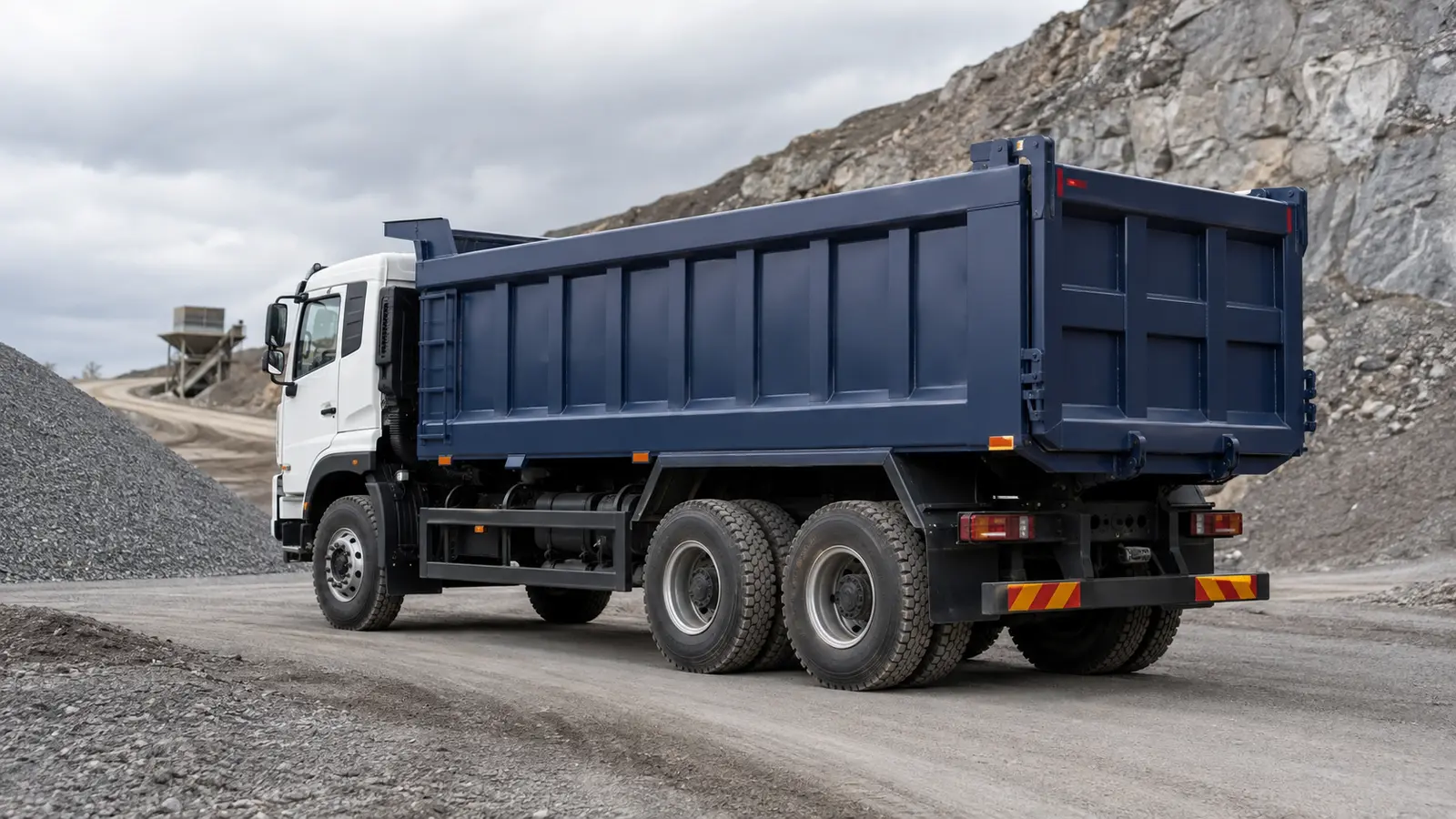
A DONGFENG 6×4 dump truck should be evaluated as a complete hauling system, not selected from the “10 wheeler” name alone. That market term commonly describes a three-axle rigid truck with one steering axle and tandem driven rear axles fitted with dual tyres, but it does not define legal payload, body capacity, engine output or road approval. The correct configuration depends on material density, route surface and gradient, loading equipment, tipping conditions, local mass limits, service access and required documentation. Buyers should confirm those inputs first, then compare the offered chassis, body, hydraulic system and acceptance evidence against one controlled project specification.
“10 wheeler” is a useful description, not a capacity rating
Wheel-count language varies between markets. In many export enquiries, “10 wheeler dump truck” refers to the visible tyre count: two tyres on the steering axle and eight across two rear axles with dual tyres. The 6×4 axle formula describes six wheel positions with four driven; it still does not state the permitted gross vehicle mass or the payload available after the cab, chassis, fuel, body and hydraulic equipment are counted.
This distinction matters because a requested payload can exceed the legal or technical limit even when the cargo body has enough space. The allowable operating mass is constrained by the lowest applicable limit among local regulations, the vehicle rating and the ratings of components such as axles, wheels and tyres. Gross mass alone is also insufficient: an individual axle can be overloaded while the truck remains below the overall limit.
The dump truck product category provides several axle and brand options, but the purchase specification should define the duty before a particular layout is released.
Define the haul cycle before choosing the truck
A sound selection begins with the material and route. Sand, soil, aggregate, ore, demolition waste and wet sludge impose different combinations of density, abrasion, impact and sticking behavior. Their effect extends beyond the body: the loaded mass changes gradeability, braking demand, tyre load and the stress placed on the chassis during repeated cycles.
Route information should include loaded and empty distance, maximum sustained gradient, tightest turning area, surface condition, expected speed and the proportion of public-road travel. A truck that works on a compacted construction route may not provide the traction or ground clearance needed on a soft mine road. Conversely, an off-road-oriented configuration can carry extra mass and rolling resistance that offer little benefit on paved transport.
Production targets need the full cycle, not merely payload per trip. Loading time, queuing, travel, unloading and return time determine how many tonnes the fleet can move per shift. A slightly smaller vehicle that matches the loader and route can outperform a larger truck that waits at the loading face, cannot turn efficiently or travels slowly on grades.
Payload must be checked against body volume and axle distribution
The basic material check is simple: required body volume is related to payload divided by loose bulk density. The engineering decision is less simple because density varies, material can accumulate above the body sides, and wet conditions can increase mass. Buyers should provide a realistic density range rather than a single optimistic value.
Body length and the location of the load centre affect axle distribution. Moving the load forward can overload the steering axle; moving it too far rearward can overload the tandem group and alter handling. This is why a general payload claim is not enough. The supplier should provide a proposed body drawing and an axle-load calculation or other documented distribution check for the offered configuration.
Tare mass also deserves attention. Thicker plate, additional reinforcement, a liner, larger fuel capacity and heavy accessories can increase durability or autonomy, but each kilogram added to the empty vehicle reduces the payload available within a fixed gross mass. The best body is the one matched to the cargo and loading method, not simply the heaviest available construction.
Match powertrain and driveline to the loaded route
Horsepower is easy to compare and easy to misuse. Loaded gradeability depends on engine torque, transmission ratios, final-drive ratio, tyre rolling radius and gross mass. Cooling demand, ambient temperature and operating altitude can also affect the suitability of a powertrain. The RFQ should therefore describe the route and expected operating speed rather than asking only for a horsepower number.
A 6×4 driveline sends power to both rear axles, providing a useful traction base for construction and haul-road work. It does not make every 6×4 suitable for every surface. Tyre pattern, tyre pressure policy, differential arrangement, suspension and road maintenance still influence traction and mobility. Buyers operating on soft, deeply rutted or very steep routes may need to compare a different axle configuration or a purpose-built off-road vehicle.
Braking equipment needs the same route context. Long descents can make auxiliary braking and thermal management more important than they appear in a flat-route quotation. The destination market may also prescribe braking, lighting, underrun protection, emissions or other road-vehicle requirements. These items must be confirmed for the actual country of operation rather than copied from a vehicle supplied elsewhere.
The body and hydraulic system form one tipping mechanism
The body, hinge, subframe where applicable, cylinder, pump, PTO, tank, valves and control system must work as a matched assembly. Body size and load centre influence the lifting force. Cylinder geometry influences the early stage of lift, the final angle and the forces transmitted through the mounting structure. Pump flow affects cycle time, while pressure capability and relief settings protect the system within its design limits.
Tailgate choice should suit the material and discharge area. A design that works for free-flowing aggregate may behave differently with wet or cohesive cargo. The operator must be able to release the load predictably, and the proposed tipping angle needs to be considered together with body geometry and material behavior.
Service access is part of the specification. Filters, hoses, seals and key hydraulic components should be identifiable, and maintenance points should not be obstructed by the installed body. For remote projects, an initial spare-parts list can be more valuable than an accessory that has no local support.
Tipping stability is an operating requirement, not an optional feature
A raised dump body moves the combined centre of gravity upward. Cross-slope, soft ground, uneven loading, material sticking to one side and poor tyre support can then reduce stability. Safe tipping requires firm, level ground, adequate overhead clearance and a load that can discharge without creating a severe side imbalance.
These operating conditions also influence procurement. A project handling sticky material may need a suitable body shape, liner or discharge aid. A site with constrained tipping areas may require a different body length or unloading plan. No truck configuration removes the need for site controls, trained operation and maintenance, but the equipment should not make the known conditions harder to manage.
The acceptance test can verify raising, holding, lowering, tailgate operation, leakage and control behavior. It cannot reproduce every field condition. The operating manual, site procedure and commissioning training must carry the remaining boundary into service.
A practical evaluation matrix
| Decision area |
Project input |
Supplier confirmation |
Evidence before release |
| Operating mass |
Target payload, local mass rules and route access |
Offered vehicle rating, tare basis and component ratings |
Configuration sheet and axle-load information |
| Cargo body |
Material, density, fragment size, abrasion and sticking tendency |
Internal dimensions, construction, tailgate and liner scope |
Approved body drawing and material schedule |
| Powertrain |
Loaded gradient, distance, speed, temperature and altitude |
Engine, transmission, axle ratio and cooling configuration |
Offered specification with declared deviations |
| Hydraulics |
Duty cycle, tipping area and discharge behavior |
PTO, pump, cylinder, tank, control and protection arrangement |
Component schedule and functional test record |
| Market compatibility |
Country, registration route, fuel and service conditions |
Offered emissions, braking, lighting and documentation scope |
Document register and responsibility matrix |
The matrix keeps the evaluation tied to a real project. It also separates three questions that are often mixed together: what the buyer needs, what the supplier is offering and what evidence will prove the match.
Inspection evidence should identify the actual truck

Generic factory photographs do not confirm a production unit. Evidence should connect the inspected vehicle to its chassis identification and the approved specification. The inspection record can cover overall configuration, key dimensions, body mounting, tyres, fluid leaks, electrical functions, lamps, cab controls, braking checks within the agreed scope, hydraulic operation, tailgate behavior and visible workmanship.
For the DONGFENG 6×4 dump truck, the product page identifies the intended model family. Production approval should still rely on the signed configuration, drawing revisions and documented deviations. If a component is offered as an equivalent, the supplier should state the change before manufacture and provide the information needed for approval.
Pre-shipment evidence should also show the final accessory and spare-parts scope. Missing tools, filters, seals or manuals may be inexpensive at origin and difficult to replace at a remote destination. A packing list linked to photographs reduces that risk.
Questions buyers often ask
Does “10 wheeler dump truck” always mean the same payload?
No. The term commonly describes a tyre arrangement, not a universal payload class. Payload depends on the vehicle rating, tare mass, axle distribution, tyre and axle limits, body design and the laws that apply where the truck operates.
Is a 6×4 dump truck suitable for mine work?
It can suit maintained mine and construction haul roads when the powertrain, tyres, suspension, ground clearance and body are matched to the duty. Very soft, steep or severely uneven routes may require another configuration. Route data should decide the answer.
How should body volume be selected?
Use the target payload and the realistic loose density of the material, then check the result against gross and axle limits. Allow for density variation and any liner or reinforcement that changes tare mass. A larger body is not automatically a higher-payload body.
What should be inspected before shipment?
Confirm the vehicle identity, offered configuration, dimensions, tyres, body mounting, electrical functions, visible leaks, hydraulic lifting and lowering, tailgate operation, accessories, spare parts and documents. The agreed inspection plan should state the test method and acceptance record.
Prepare the RFQ around the job the truck must perform
Send the operating country, material and density range, target payload, loading equipment, haul distance, maximum gradient, road condition, tipping area, shifts per day, desired body features, inspection scope, document requirements, quantity and delivery window. Ask the supplier to return the complete offered configuration, proposed body drawing, hydraulic component schedule, included spares, document list and every deviation from the request.
Those details can be submitted through the technical project inquiry form. A useful response should make the truck’s technical boundary visible before price comparison or production approval, especially where the local meaning of “10 wheeler” differs from the supplier’s default configuration.