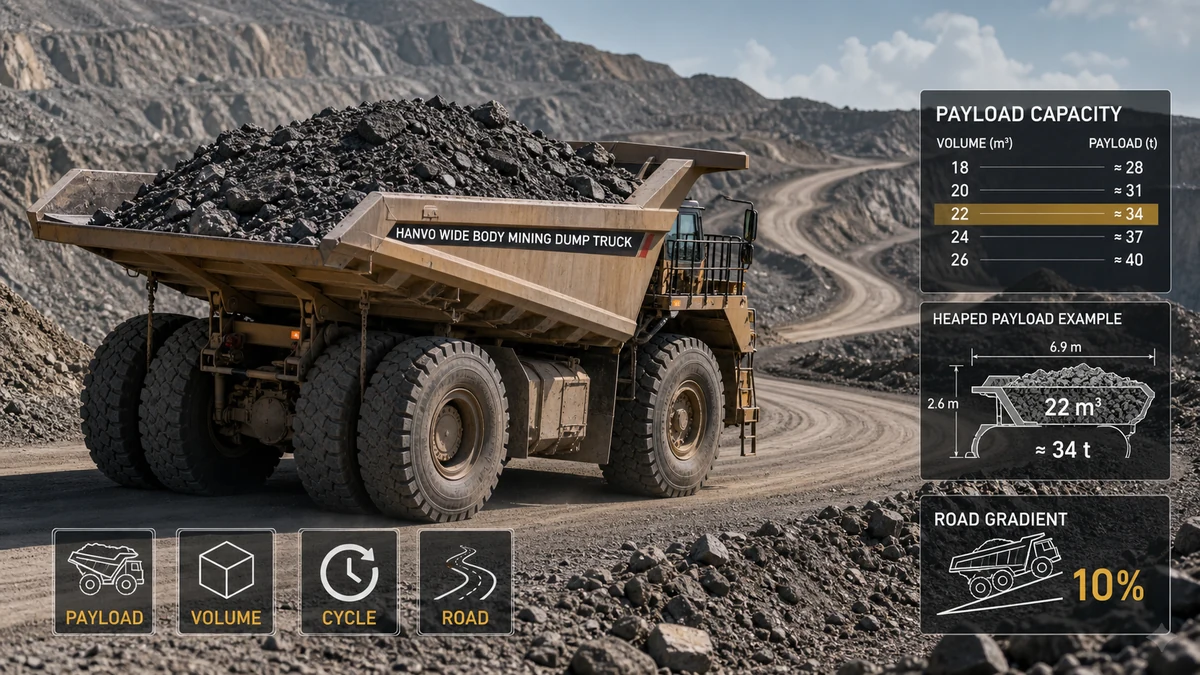
Direct Answer: Select articulated dump truck capacity by the lowest practical limit created by payload rating, body volume, material density, road gradient, rolling resistance, ground bearing, braking, loader match, and target cycle time. A larger nominal payload is not automatically more productive on soft or steep routes; the correct truck is the one that can carry repeatable loads without excessive wheel slip, queuing, tire heat, or dumping risk.
This decision is most relevant to mines, quarries, earthmoving contractors, infrastructure projects, fleet owners, equipment dealers, and government project buyers operating beyond prepared public roads. Buyers should begin with route and production data, not a preferred tonnage label. Wentu’s dump truck product category shows the available mining and road-going dump truck range, while the final configuration must be confirmed against the project’s actual haul conditions.
How Should Haul-Road Conditions Change the Capacity Decision?
Articulated dump truck capacity should be treated as an application result rather than a catalog starting point. The same nominal payload can perform very differently on a compacted quarry road, a rain-softened clay route, a steep cut-and-fill project, or an unprepared mine bench. The truck must repeatedly complete the route while maintaining traction, braking control, tire condition, loading balance, and safe dumping.
| Haul-Road Condition |
Capacity Implication |
Buyer Evidence to Collect |
Risk of Selecting by Nominal Payload Alone |
| Steep sustained gradients |
Usable payload may need to be below the headline rating if loaded speed, cooling, retarding, or braking becomes the route constraint. |
Maximum sustained gradient, short peak gradient, loaded travel direction, curve locations, speed targets, and braking zones. |
Slow climbing, overheating, brake stress, reduced cycles per hour, and pressure to overload other trucks. |
| Soft or low-bearing ground |
Higher nominal capacity can increase ground pressure, rutting, recovery risk, and seasonal downtime. |
Surface type, bearing condition, rainfall pattern, rut depth, drainage, recovery history, and tire requirements. |
Wheel slip, bogging, road damage, tow events, tire damage, and lost production. |
| Unprepared or changing haul roads |
Capacity should preserve maneuverability and traction as route width, crossfall, surface and turning conditions change. |
Road width, turning radius, crossfall, edge condition, temporary ramps, dumping access, and route-change frequency. |
Limited access, unstable dumping positions, collision risk, and underused body capacity. |
| Long loaded hauls |
Cycle productivity depends on travel speed, fuel use, tire heat and queue control, not only tonnes per trip. |
Loaded distance, empty return distance, average speeds, intersections, queue points, and shift utilization. |
A larger truck carries more per trip but completes too few trips to meet hourly production. |
| Short shuttle routes |
Loader passes, spotting, tipping and traffic coordination can become more important than maximum body size. |
Loader cycle, truck positioning time, pass count, dump time, and space at loading and dumping points. |
Oversized trucks queue, wait for loading, or cannot maneuver efficiently. |
An experienced fleet buyer separates dry-season capability from all-season capability. A route that supports a heavier truck during commissioning may become the fleet bottleneck after rainfall or repeated traffic. Capacity approval should therefore use the worst operating condition the project expects to manage, not only the best road condition observed during a supplier visit.
Why Must Rated Payload Be Separated From Practical Payload?
Rated payload is a product value. Practical payload is the repeatable load that the truck can carry on the specific route while remaining within the project’s operating, safety, tire, braking, loading, and dumping limits. The purchasing decision should use the lower of these constraints.
A practical review should distinguish:
- Rated payload: the payload stated for the proposed vehicle configuration.
- Route-limited payload: the load that can be moved through the steepest, softest, narrowest, or least stable route section.
- Volume-limited payload: the mass that fits in the body after material density, swell and realistic fill are considered.
- Loading-limited payload: the repeatable load produced by the excavator or loader without excessive passes or overload peaks.
- Site-permitted payload: any project, bridge, ramp, axle, ground, or internal traffic limit that applies to the route.
One frequent buyer mistake is using the body’s cubic volume as proof of payload. Light overburden, wet clay, crushed rock and dense ore can fill the same body to very different masses. The existing guide on comparing dump truck capacity across axle configurations can support the mass-versus-configuration review, but an off-road selection still needs route resistance and ground data.
Another hidden risk is average-load reporting. A fleet may show an acceptable average while individual trucks are repeatedly overloaded and others are underfilled. Buyers should define the acceptable loading band and the method used to verify it during operation.
How Do Gradient and Rolling Resistance Affect the Usable Capacity?
Gradient and rolling resistance act together. A moderate slope on firm compacted ground may be less restrictive than a smaller slope through deep ruts or soft material. The route survey should therefore record both geometry and surface condition.
The buyer should map:
- Maximum sustained gradient and its length
- Short peak gradients at ramps, benches and dumping areas
- Loaded and empty travel direction
- Soft sections, ruts, loose rock and water crossings
- Curves, crossfall, narrow sections and blind approaches
- Intersections, stopping points and restart-on-grade locations
- Seasonal changes in surface resistance
- Road maintenance frequency and available support equipment
A truck that can climb the route once is not automatically suitable for production. The selection must consider repeated loaded climbs, cooling recovery, braking on the return route, tire temperature, operator variation, and the effect of traffic queues. A larger capacity may reduce trips on paper while increasing the time and variability of every cycle.
Industry experience shows that route averages can hide the real constraint. A short steep ramp or one soft crossing may control the usable payload for the entire haul. The RFQ should identify these critical sections separately rather than reporting only average gradient and total distance.
How Should Ground Bearing and Weather Be Included in Capacity Selection?
Soft ground changes more than traction. It affects rut formation, steering control, underbody clearance, tire damage, fuel use, recovery requirements, and the cost of maintaining the haul road. A heavier truck may create more road work than its additional payload can justify.
Before comparing truck capacities, document:
| Ground and Weather Input |
Why It Matters |
Procurement Question |
| Surface material and bearing condition |
Controls sinkage, traction, rutting and recovery risk. |
What loaded configuration can operate repeatedly without unacceptable road damage or bogging? |
| Rainfall and drainage |
Changes resistance, visibility, braking and route availability. |
Is capacity based on dry operation only, or on the required operating season? |
| Road maintenance capability |
Determines whether route deterioration can be corrected before production falls. |
What graders, dozers, drainage work and recovery equipment are available? |
| Tire specification and support |
Affects flotation, traction, heat, damage rate and downtime. |
Are the proposed tires suitable and supportable at the project location? |
| Dumping-area bearing and level |
The truck is most vulnerable when loaded and raising the body. |
Can the loaded vehicle stand level and stable through the complete tipping cycle? |
A common short-term cost mistake is selecting the higher-payload truck while excluding road maintenance, tire loss, recovery time and wet-season production from the comparison. Installed fleet cost should include the route that the vehicle requires, not only the purchase price of the vehicle.
How Should the Excavator or Loader Determine the Truck Size?
Loader matching is a production calculation, not a simple comparison of rated bucket volume with body volume. The buyer should use actual material fill, bucket payload, operator consistency, spotting time and the acceptable number of passes.
Too few passes can create large load variation and overload peaks. Too many passes increase loading time and make the loader wait for truck positioning. An apparently larger truck may reduce fleet balance when the loader cannot fill it quickly and consistently.
For each loading unit, provide:
- Machine model and bucket type
- Realistic bucket payload for the target material
- Expected bucket fill rather than theoretical bucket volume
- Target passes per truck
- Average pass time and truck spotting time
- Loading-face access and swing restrictions
- Peak fragment size and body-impact considerations
- Whether the same truck will be loaded by multiple machines
Buyers also need to compare body geometry with the loading unit. A body can have adequate volume but still be difficult to load evenly because of side height, target area or material distribution. Uneven loading can affect axle load, traction, stability and tire wear before the truck leaves the loading area.
Why Is Tonnes per Operating Hour More Useful Than Tonnes per Trip?
Capacity should support the production target across the complete cycle. The useful comparison is not only payload per trip but payload multiplied by repeatable completed cycles, adjusted for queueing, road conditions, availability and operating delays.
A cycle model should include:
- Truck positioning and loading
- Loaded travel
- Queueing at intersections or the dump point
- Positioning and tipping
- Empty return
- Operator change, refueling and planned checks
- Road-related delay and recovery allowance
- Expected mechanical and tire availability
One of the most expensive buyer errors is sizing the truck independently from the fleet. A larger unit can improve tonnes per trip while creating loader queues, dump-point congestion or insufficient redundancy. Fleet balance should compare the required number of active trucks, standby coverage, loader utilization and the production loss caused by one vehicle being unavailable.
When quotations use different payloads, do not compare vehicle price alone. Normalize the proposals to cost per achievable operating tonne under the same route, shift, material and support assumptions.
What Braking, Tire, Maneuvering, and Dumping Checks Limit Capacity?
The capacity decision must remain within the control limits of the complete operating route. Loaded downhill sections, restart points, sharp turns, narrow benches and uneven dumping areas can all reduce the practical capacity below the catalog rating.
Buyers should request configuration-specific confirmation of:
- Service braking and retarding arrangement for the route profile
- Tire type, availability, pressure guidance and replacement support
- Turning and articulation clearance at the narrowest route sections
- Visibility, reversing support and any required camera or warning arrangement
- Body lifting and lowering control
- Dumping stability requirements and permitted surface condition
- Recovery and towing points
- Daily inspection access and routine service requirements
Do not approve a capacity that requires the operator to tip on crossfall, soft fill or an inadequately compacted edge. Dumping-area preparation is part of the vehicle selection because the truck cannot deliver its rated production when the body cannot be raised safely and repeatedly.
Can Wentu’s Wide-Body Mining Dump Trucks Be Treated as Articulated Dump Trucks?
No. Buyers should not treat a wide-body mining dump truck and an articulated dump truck as interchangeable descriptions. The current Wentu product database includes models such as the Hanwo wide-body mining dump truck and the Weichai mining wide-body dump truck. These are relevant adjacent haul-truck references, but the correct vehicle type must be confirmed against route geometry, ground condition, traction requirements and the exact project scope.
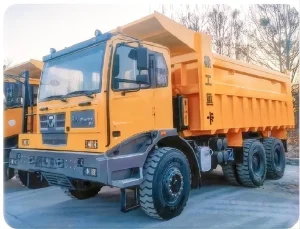
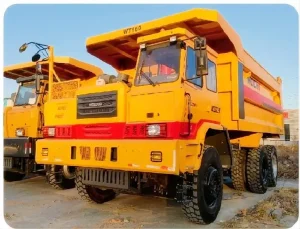
This distinction is important during supplier evaluation. A quotation should identify the vehicle architecture, drive arrangement, steering or articulation arrangement, body, chassis, payload basis and intended duty. A supplier should not satisfy an articulated-truck RFQ merely by offering a high-capacity mining truck with a similar application description.
What Does a Representative Capacity-Selection Scenario Look Like?
Scenario: Capacity selection for a seasonal overburden haul route. This is an illustrative application scenario used to show the procurement method; it is not presented as a completed Wentu customer case.
Business Background: A contractor must move overburden between an excavation face and a temporary dumping area. The route includes a sustained climb, several tight bends, one soft low-lying section, and a dumping platform that changes as the project advances. Production must continue during part of the rainy season.
Problem: Purchasing initially favors the highest nominal payload because it appears to reduce the number of trucks. The loader team prefers a smaller body because the larger proposal requires more passes and longer spotting. The site team is concerned about rutting and recovery in the soft section.
Cause: The first comparison uses tonnes per trip and purchase price but omits wet-season route resistance, actual loader passes, queue time, tire support, dumping-area bearing and the production effect of one truck being unavailable.
Solution: The project separates rated payload from practical route payload, surveys critical gradients and soft sections, confirms realistic material density and bucket payload, models the complete cycle, and sets acceptance criteria for traction, loaded travel, loading passes, tipping stability and repeatability. Shortlisted vehicles are compared under the same route and production assumptions.
Buyer Decision Value: The final decision is based on achievable tonnes per operating hour and route risk rather than maximum advertised payload. This prevents a lower vehicle count from creating higher road-maintenance cost, loader delay, recovery events, tire loss and wet-season downtime.
What Information Should an RFQ Include Before Requesting a Capacity Recommendation?
| RFQ Section |
Information the Buyer Should Provide |
Supplier Response Required |
| Material |
Material type, loose bulk density range, moisture variation, swell, fragment size and loading method. |
Payload and body assumptions used for the proposed configuration. |
| Route |
Loaded and empty distances, sustained and peak gradients, curves, width, crossfall, surface, drainage and seasonal condition. |
Route limitations, expected operating condition and any assumptions requiring confirmation. |
| Ground |
Soft sections, bearing concerns, rut history, rainfall, road-maintenance resources and recovery capability. |
Tire, traction, ground-clearance and recovery recommendations. |
| Loading |
Excavator or loader model, actual bucket payload, target passes, loading time and loading-area access. |
Body match, target load band and loading-trial method. |
| Production |
Required tonnes per hour or shift, working hours, expected availability, shift pattern and fleet redundancy. |
Cycle assumptions, recommended active fleet and production estimate basis. |
| Safety and dumping |
Loaded downhill sections, braking zones, dump-area bearing, crossfall, visibility and traffic-control requirements. |
Braking, retarding, maneuvering, warning and tipping-condition confirmation. |
| Commercial scope |
Quantity, destination, delivery target, spare parts, training, documentation, inspection and packaging requirements. |
Exact supply scope, exclusions, lead time, spare-parts package, export documents and quotation basis. |
The RFQ should ask the supplier to list every assumption and deviation. Capacity recommendations become unreliable when one proposal assumes dry compacted roads while another assumes wet-season operation, or when one supplier quotes rated payload and another uses a route-limited value.
Frequently Asked Questions
Is the largest articulated dump truck capacity always the most productive?
No. A larger nominal payload can reduce productivity when it causes slower climbing, more wheel slip, longer loading, dump-point congestion, tire heat, road damage or reduced availability. Compare achievable tonnes per operating hour under the same route conditions.
How should buyers convert body volume into payload?
Use the hauled material’s realistic loose bulk density, expected moisture, swell and fill factor. The practical payload is limited by both the calculated material mass and the vehicle or route payload limit.
Should capacity be selected using dry-season or wet-season conditions?
Use the operating condition required by the project. When production must continue during wet periods, the route survey and capacity decision should include the expected soft-ground, drainage, traction and road-maintenance conditions.
How many loader passes should be used to fill the truck?
There is no universal pass count. The preferred range depends on actual bucket payload, material variation, loading time, body geometry and overload control. Compare repeatable loading performance rather than theoretical bucket and body volumes.
Why can a smaller truck outperform a larger truck on a steep route?
A smaller truck may maintain higher repeatable speed, experience less wheel slip, require less road maintenance, load faster and complete more cycles. The decision should be based on fleet output and route risk, not payload per trip alone.
What evidence should a supplier provide for a capacity recommendation?
The supplier should state the proposed vehicle type and configuration, payload basis, body assumptions, route limitations, tire and braking arrangement, loader-match assumptions, cycle model, spare-parts scope, documentation and all exclusions.
Can a wide-body mining dump truck replace an articulated dump truck?
Not automatically. They are different vehicle categories and may suit different route, traction, steering and ground conditions. The project must compare the exact architecture and configuration against the haul-road data.
Request a Haul-Route and Capacity Review
Provide the material density range, route drawing, loaded and empty distances, maximum gradients, ground condition, rainfall pattern, loader or excavator data, target hourly production, dumping-area condition, fleet quantity, destination and required spare-parts package through Wentu’s contact and quotation page. The team can review available dump truck configurations, identify missing route or loading data, compare suitable product options, and prepare a project-specific quotation with stated assumptions and exclusions.