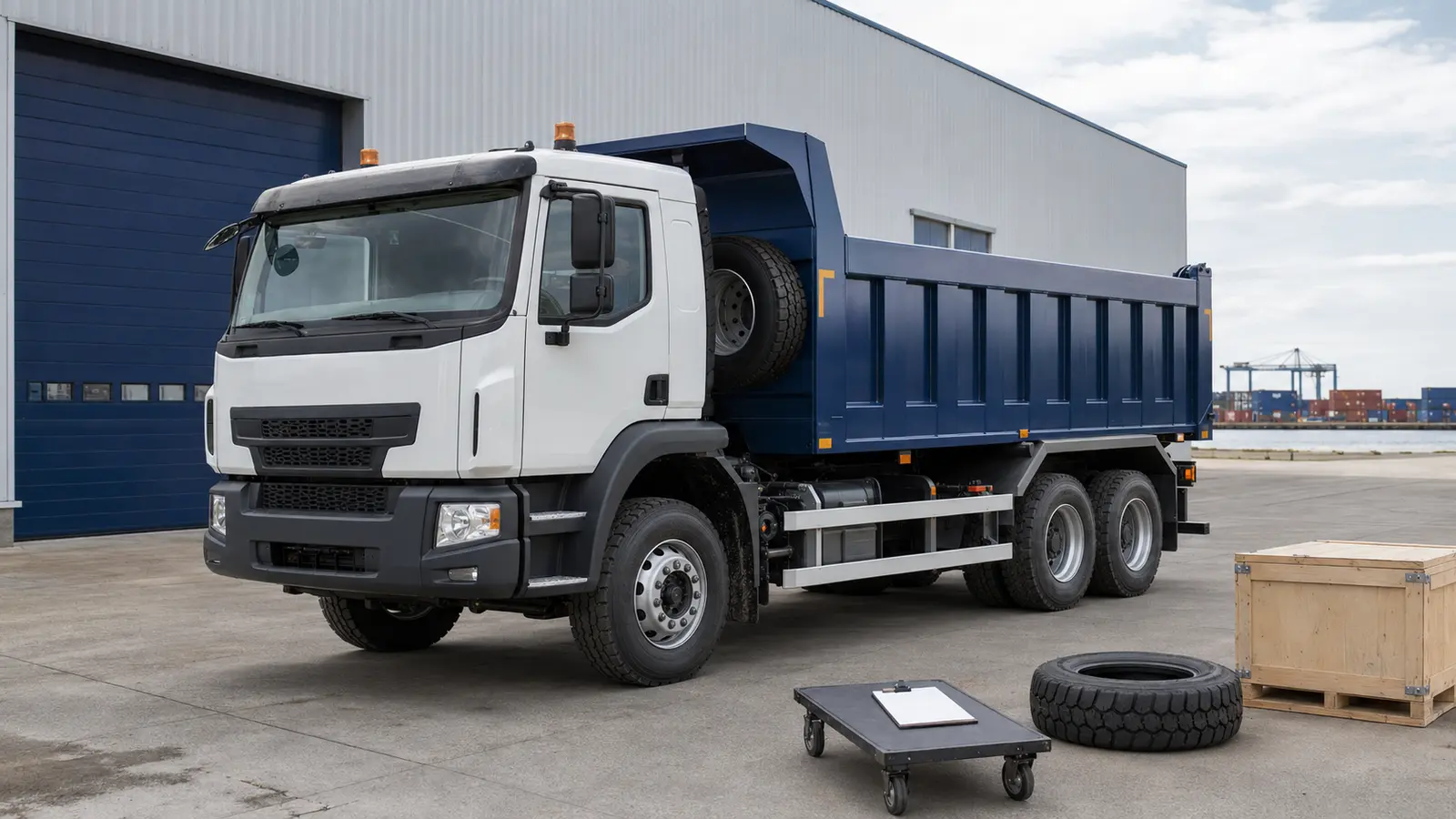
A dumper truck price is only meaningful when the quoted vehicles have the same technical and commercial scope. Two offers may use the same axle formula and a similar-looking body yet differ in chassis configuration, engine and emissions package, transmission, axle ratings, body material, hydraulic system, tyres, inspection documents, spare parts, delivery term and destination costs. The lower figure may therefore describe a smaller scope rather than a better purchase. Before comparing totals, buyers need a common RFQ schedule and a supplier deviation list. Once those boundaries are fixed, price, lead time and payment terms can be judged on comparable ground.
Start with the quotation boundary, not the total
A price for a tipper truck can describe several different things: a complete road-ready vehicle, a chassis with a locally installed body, a truck without certain export documents, or a unit quoted only at the supplier’s premises. Even the phrase “standard configuration” is unreliable unless the standard is identified in writing.
The first comparison should therefore ask what the seller has included. A practical quotation separates the vehicle, body and tipping equipment from optional parts, inspection work, packing, inland transport and international freight. It also identifies the delivery location and trade term precisely. Freight paid by the seller does not necessarily mean that risk transfers at the destination, so the named place and the selected Incoterms rule must appear together in the offer.
Buyers reviewing the broader dump truck range for mining and construction projects should use the same boundary for every shortlisted configuration. Otherwise, a component omitted from one offer can reappear later as an option, a local installation cost or a commissioning delay.
The vehicle specification changes both purchase price and operating fit
Axle configuration is an obvious cost driver, but it is not a complete selection rule. A 4×2, 6×4, 6×6 or 8×4 truck places different limits on traction, legal loading, turning space, chassis mass and body length. The final choice depends on whether the vehicle will work mainly on public roads, compacted construction routes, quarry roads or soft mine surfaces.
Engine output also needs context. A higher horsepower figure can raise the initial quotation, yet route gradient, vehicle mass, transmission ratios and expected speed determine whether that output is useful. The same applies to emission configuration. A system required for one destination may add hardware, sensors and after-treatment components that are unnecessary or unsuitable for another market. Fuel quality, diagnostic capability and local parts support should be considered before an emission package is frozen.
Transmission, drive axles, suspension, steering axle rating, braking equipment and tyres form one system. Changing tyre size may affect ground clearance, gearing, load rating and replacement availability. Changing the rear axle ratio can improve gradeability at the expense of cruising speed or fuel use. A quotation that lists only horsepower and nominal payload leaves too much unresolved.
Body volume is not the same as payload
The dump body is often the largest visible difference between offers. Its cost is influenced by internal dimensions, floor and side construction, material grade, plate thickness, reinforcement, subframe arrangement, tailgate design, liner requirements and surface protection. None of these variables should be chosen from cubic capacity alone.
Material density connects the body to the chassis. A body sized for low-density material may reach its volume limit before the vehicle reaches its permitted mass. Dense rock can create the opposite condition: the legal or structural mass limit may be reached while much of the body still appears empty. Oversizing the body for dense material adds tare weight and can encourage overloading. Undersizing it for light material wastes trips.
That relationship explains why two visually similar trucks can carry different quotations. One body may be intended for sand or soil, another for abrasive ore, and a third for mixed construction waste. The RFQ should state the material, expected density range, typical fragment size, loading method and desired payload. The supplier can then propose a body rather than merely pricing a box.
The tipping system must match the body and duty cycle
A truck-mounted tipping system normally combines the body and hinge assembly with a subframe where required, a hydraulic cylinder, pump, power take-off, oil tank, valves, hoses and controls. Different cylinder arrangements, operating pressures, mounting geometry and component brands can materially change a quote. They also change serviceability.
The lowest hydraulic price is not automatically the lowest project cost. If the cylinder stroke or mounting geometry is poorly matched to the body, the system may not deliver the intended tipping angle or lifting behavior. If the pump and PTO are not compatible with the transmission and required flow, cycle time and component temperature can become problems. Hose routing, filtration, seals and local replacement availability matter in dusty or remote operations.
Ask each bidder to identify the offered hydraulic architecture and major component makes without implying that one brand is universally required. The useful question is whether the system is correctly sized, documented and supportable in the destination market.
Where quote differences usually originate
| Quotation area |
What may differ |
What the buyer should request |
| Chassis |
Axle formula, engine, transmission, axle ratings, suspension and wheelbase |
Complete offered specification and a list of deviations from the RFQ |
| Dump body |
Internal size, material, plate construction, reinforcement, tailgate and liner |
Approved body drawing, tare estimate and intended material/application |
| Hydraulics |
Cylinder arrangement, PTO, pump, tank, valves, hoses and control method |
Component schedule, operating description and service-part identification |
| Tyres and accessories |
Tyre brand and size, spare wheel, tools, guards, tarp and warning equipment |
Included quantity, make or approved equivalent, and optional-price list |
| Inspection and documents |
Test scope, reports, photos, manuals, origin documents and destination paperwork |
Document register showing included, optional and buyer-supplied items |
| Delivery |
Factory handover, inland haulage, port handling, freight and insurance |
Named place, Incoterms rule and cost exclusions |
This structure prevents a common error: comparing one fully specified truck with another offer that still contains unresolved placeholders. It also makes later revisions visible. If the body material or tyre brand changes after the quotation, the commercial effect can be traced to a specific line rather than absorbed into a new total.
Accessories and documentation can create a large scope gap
Small items become expensive when they are discovered after arrival. A spare wheel, wheel tools, fire extinguisher bracket, rear protection, mudguards, lighting arrangement, reverse alarm, body cover or cab accessories may be standard in one offer and optional in another. The same is true for initial filters, belts, seals and hydraulic service parts.
Documents deserve their own schedule. The buyer may require a commercial invoice, packing list, certificate of origin, chassis identification records, manuals, parts catalogue, inspection report, photographs before dispatch or destination-specific conformity documents. These do not all come automatically with every vehicle. Some depend on the market, the product configuration or third-party inspection.
“All documents included” is too vague for an export order. A document register should name each deliverable, language, format, responsible party and submission stage. If a document cannot be supplied, the deviation belongs in the quotation—not after production.
Inspection scope affects what the quotation can prove
A supplier’s statement that the truck has been inspected does not define the acceptance standard. The scope may range from a visual check to a documented functional inspection. For a dumper, useful evidence can include identification photographs, configuration records, dimension checks, fluid and leakage checks, electrical and lighting checks, tyre information, body operation, tailgate function and hydraulic lifting and lowering behavior.
The inspection plan should distinguish factory verification from destination registration or road approval. A vehicle can pass the agreed supplier inspection and still require local certification, modification or registration work. Those obligations depend on the importing market and should not be assumed from a generic export claim.
If the purchase is based on a representative model such as the HOWO 6×4 dump truck, the model page is a starting point for discussion, not a substitute for the signed specification. The approved configuration sheet and purchase order remain the commercial reference.
Delivery terms can make two identical trucks look differently priced
A factory-level price excludes costs that may appear in a port or destination quotation. Inland transport, loading method, port charges, export handling, ocean freight, insurance, destination charges, import duty, taxes, local transport and unloading can all sit on different sides of the contract.
The named place matters as much as the three-letter trade term. “FOB China” does not identify a specific port, and “CIF destination” does not identify the exact port or the scope of destination charges. The quotation should state the named port or place and the applicable Incoterms edition. It should also show whether freight is firm, estimated or subject to reconfirmation.
Packaging and shipping method may also change vehicle preparation. Some projects ship complete units; others require partial disassembly, protective measures or special lifting arrangements. The supplier should identify what will be removed, how it will be protected and what reassembly is required after arrival.
A comparable RFQ fixes the variables before price review
A useful dumper truck RFQ does not need to prescribe every engineering detail. It does need enough information for all suppliers to price the same task.
- Operating country, road-registration requirement and intended worksite
- Material type, density range, fragment size and loading equipment
- Target payload, trips per shift, route distance, gradient and road condition
- Preferred axle formula, cab orientation and powertrain constraints
- Body style, approximate internal dimensions, tailgate and liner requirements
- Hydraulic control, tipping-cycle expectations and preferred service parts
- Tyres, accessories, initial spare parts and documentation
- Inspection or third-party witness requirements
- Quantity, required delivery window, named place and trade term
In return, each supplier should provide the offered specification, included accessories, document scope, inspection plan, lead-time basis, delivery boundary and a separate deviation list. Optional items should be priced separately. That format exposes real technical and commercial differences without forcing buyers to guess why one dumper truck price is lower.
Move from budget price to a controlled quotation
A budget figure is useful early in a project, but purchase approval needs a frozen scope. Prepare the operating conditions, material data, target payload, body requirements, inspection expectations, quantity and delivery basis, then submit them through the project quotation form. The supplier’s response should identify the exact offered configuration, exclusions, optional items and deviations. Only then can price and lead time be compared without hiding a scope difference inside the total.