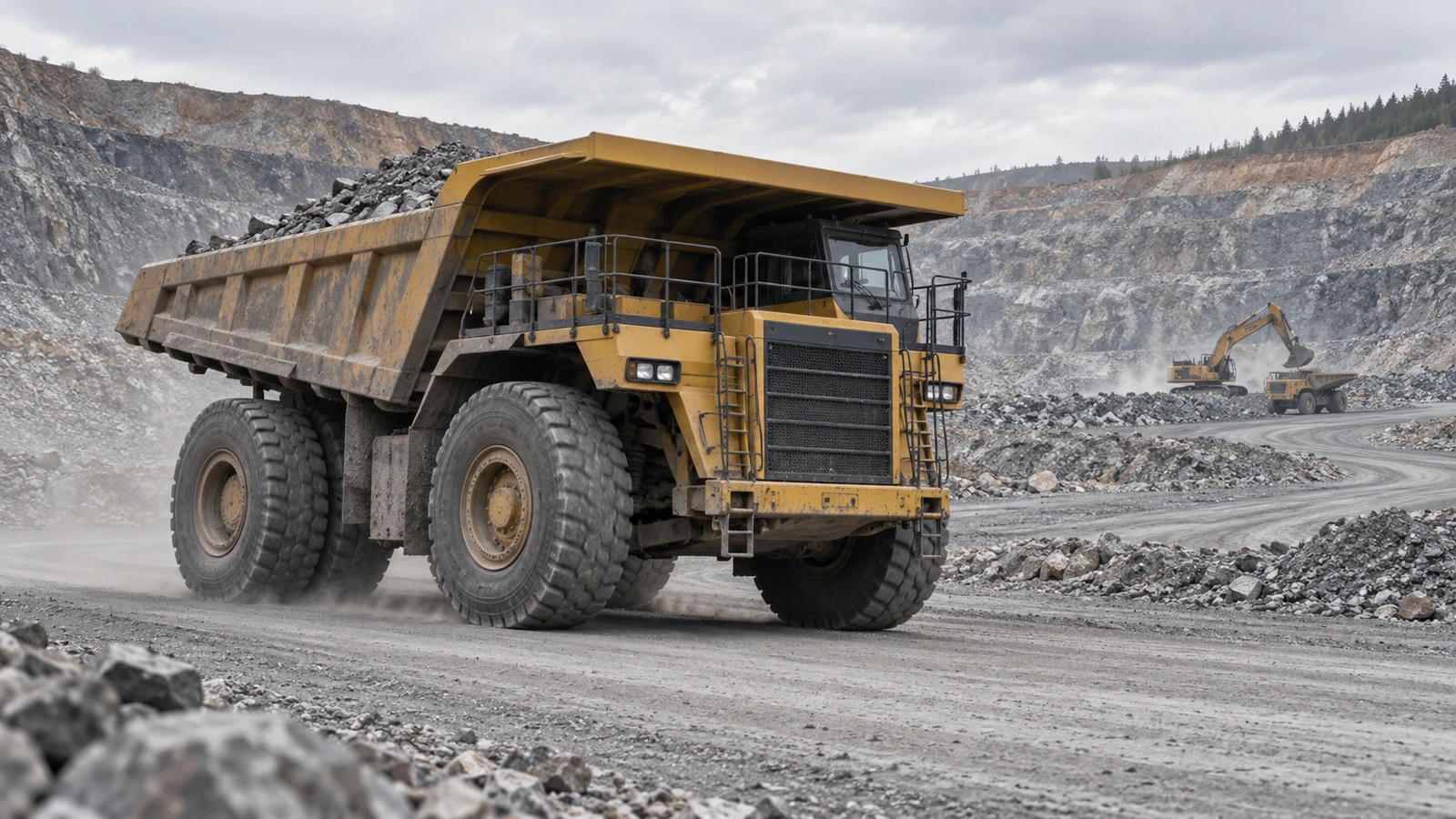
Buyers comparing commercial dump trucks for sale should start with the haul duty, not a model name or a headline payload. The correct truck depends on the material, legal or site-controlled operating mass, loading method, route surface, grade, cycle distance, tipping area, climate, service capability and required documentation. A wide-body mining truck, an on-road rigid dumper and an articulated truck solve different transport problems even when their body volumes appear similar. Before requesting a quotation, define the operating envelope and ask every supplier to return the same configuration fields, assumptions, deviations and evidence. That turns a price list into a technically comparable offer.
Why Must Buyers Define the Haul System Before the Truck?
A dump truck is one element in a loading, transport, unloading and return cycle. Its useful capacity depends on whether the excavator or loader can fill it efficiently, whether the road supports its axle and tyre loading, whether the unloading area provides stable ground and overhead clearance, and whether the empty-return speed fits site rules. Selecting the vehicle in isolation can create queues at the loading face, excessive partial loads, unstable tipping conditions or maintenance demands the site cannot support.
First decide whether the unit will operate primarily on a closed mine or construction site, on public roads, or across both. Regulatory registration, dimensions and axle-loading rules may matter for an on-road vehicle, while a site-only wide-body truck is evaluated against mine-road geometry, production targets and site safety controls. These are not interchangeable assumptions.
Which Application Inputs Should Be Frozen First?
| Buyer input | Why it matters | Supplier confirmation | Risk if missing |
| Material and bulk density | Connects body volume to realistic payload | Body type and volume basis | Volume or mass mismatch |
| Loaded operating mass | Defines chassis and drivetrain duty | Mass definition and assumptions | Misleading payload comparison |
| Road type and condition | Affects traction, tyres and suspension duty | Recommended configuration | Poor mobility or tyre life |
| Maximum and sustained grade | Changes startability, cooling and braking duty | Route-based review | Slow cycles or overheating risk |
| One-way distance and cycles | Sets production and fuel demand | Duty-cycle assumptions | Unrealistic output forecast |
| Loader or excavator | Controls pass match and impact loading | Loading compatibility | Queues or body damage |
| Tipping area | Controls stability and clearance | Body and hoist arrangement | Unsafe or unusable discharge |
| Altitude and temperature | Affects power and cooling review | Derating or special configuration | Unsuitable sustained duty |
How Should Payload and Body Volume Be Compared?
Body volume is a geometric value; payload is a mass value. The material bulk density and the permitted operating mass connect the two. A large body carrying dense rock may reach the allowed mass before it is full, while a lighter material may fill the body first. Buyers should therefore provide both material description and expected density, then ask the supplier to state the body-volume convention, payload basis, vehicle mass assumptions and any site or regulatory limit used in the proposal.
The loading tool matters as well. Bucket size, pass count, drop height and the distribution of material in the body influence cycle efficiency and impact. A nominally larger truck does not automatically improve tonnes per hour if the loading unit creates long pass times or poor load distribution.
How Do Route Surface, Grade and Turning Space Change the Choice?
Paved logistics routes, compacted quarry roads and soft mine roads impose different requirements. Buyers should document minimum road width, curve radius, ramp transitions, loose surface, drainage condition and seasonal deterioration. Grade data should include both the maximum slope and how long it continues; a short ramp and a sustained climb are different thermal and drivetrain duties.
Traction cannot be inferred from drive configuration alone. Tyre type and size, surface condition, axle loading, vehicle mass and operating practice interact. Likewise, downhill operation brings braking and retarding duty into the review. Ask the supplier to identify what route assumptions support the offered configuration rather than accepting a general statement that the truck is suitable for mining or construction.
Why Should the Powertrain Be Reviewed as a System?
Engine output reaches the ground through the transmission, drive axles and tyres. Engine model, torque delivery, gear ratios, axle ratio, tyre rolling radius and loaded mass together determine starting, climbing and travel behaviour. Two quotations cannot be ranked by horsepower alone if their transmissions, axles or tyres differ.
For every offer, request the exact engine and transmission models, axle configuration and ratio, tyre specification, cooling arrangement and fuel-tank scope. Where the supplier offers alternatives, the quotation should explain which operating assumption each option addresses. A product-family range is not proof that every option is included in one quoted unit.
Which Body and Tipping Details Affect Application Fit?
The buyer should identify the hauled material, abrasion and impact exposure, loading tool, required tailgate arrangement, discharge method and contamination limits. The supplier should confirm body dimensions, stated volume basis, structural and liner scope where applicable, hoist arrangement and included safety or operating features. Do not infer plate thickness, material grade or hoist performance from a photograph; these must be stated in the quotation or controlled technical documents.
Tipping compatibility also depends on level ground, overhead clearance, body-up stability and site procedure. The RFQ should describe the discharge location and any physical constraint. Acceptance should verify the delivered configuration and controlled functions under the agreed procedure, not encourage improvised field testing.
When Is a Wide-Body Mining Truck a Relevant Starting Point?
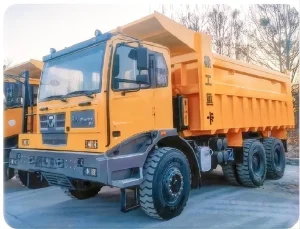
A wide-body mining truck can be a relevant evaluation path for closed-site haulage where mine-road conditions, production cycles and site maintenance govern the decision. It should not automatically be treated as the equivalent of an on-road commercial dumper. Buyers can first review Juxiang’s dump truck product range to distinguish available vehicle families.
The HANWO wide-body mining dump truck page provides a concrete product-family reference for a project discussion. The buyer must still obtain the exact quoted engine, transmission, axle, tyres, body, operating mass definition, optional equipment and documentation. A webpage identifies an evaluation starting point; the approved quotation and specification define the supplied vehicle.
What Evidence Makes Competing Quotations Comparable?
Require a configuration sheet tied to the quotation revision. It should separate standard scope, included options, excluded items and buyer inputs still required. The mass and capacity definitions should be explicit. Product drawings, interface dimensions, major-component data, inspection scope, manuals, spare-parts proposal and export documents should be identified according to the project.
A useful comparison register gives each supplier four response choices: Confirmed, Deviation, Alternative, or Buyer Input Required. This exposes silent assumptions before purchase-order release. It also prevents a lower price from hiding a different body, tyre, powertrain, documentation or commissioning scope.
What Common Shortcuts Create Procurement Risk?
- Buying by body volume: material density and permitted mass remain undefined.
- Buying by horsepower: drivetrain, route and cooling duty are ignored.
- Using “mining truck” as a complete specification: road, grade and cycle inputs are missing.
- Comparing different option scopes: tyres, liners, spares or documents differ between bids.
- Skipping site-service planning: maintenance capability and critical spares are considered after delivery.
What Should a Commercial Dump Truck RFQ Include?
- Haul material and expected bulk density.
- Payload target and loaded operating-mass basis.
- Public-road, closed-site or mixed operation.
- One-way distance, cycles per shift and operating hours.
- Maximum grade and sustained-grade length.
- Road surface, width, curve radius and seasonal condition.
- Loading equipment, bucket size and preferred pass count.
- Discharge method, tipping area and overhead clearance.
- Altitude, ambient-temperature range and dust conditions.
- Required powertrain, drive configuration, tyres and braking/retarding review.
- Body, tailgate, liner and hoist requirements.
- Fuel preference and refuelling constraints.
- Inspection, manuals, certificates and acceptance evidence.
- Spare parts, service conditions and operator/maintenance support required.
- Quantity, destination, delivery terms and schedule.
Send these inputs through the commercial vehicle project inquiry form. Ask the supplier to return the offered configuration, assumptions, deviations and alternatives before comparing price or approving a unit.