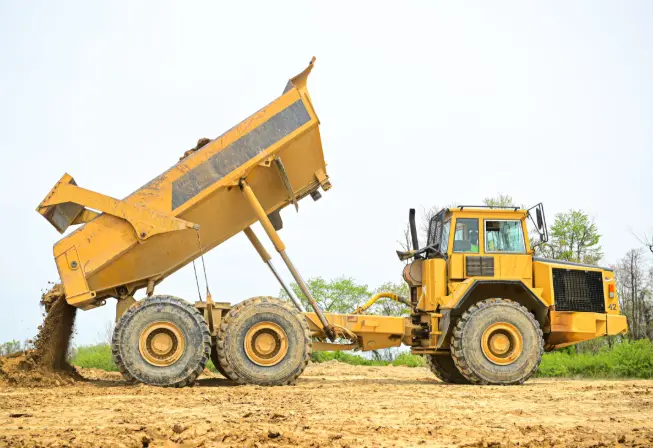
The main difference between a dumper and a dump truck is their intended operating environment. A dumper is usually a compact, highly maneuverable vehicle designed for construction sites, farms, quarries, and off-road work. A dump truck is generally a larger road-going truck with a tipping body, designed to transport bulk materials over longer distances and, in many cases, operate on public roads.
The terms are sometimes used interchangeably, especially in different English-speaking markets. However, equipment buyers should distinguish between a site dumper, an articulated dumper, a rigid mining dumper, and a commercial dump truck before comparing payload, dimensions, drivetrain, or price.
What Is a Dumper?
A dumper is a self-propelled vehicle with an open tipping body used to carry and discharge materials such as:
- Soil
- Sand
- Gravel
- Rock
- Construction waste
- Agricultural materials
- Demolition debris
Many dumpers are designed for short-distance material movement within a worksite. They may have compact dimensions, high ground clearance, low-speed gearing, and off-road tires.
Some dumpers use a forward tipping body, while others use a swivel or rotating body that allows the operator to discharge material to the side. Articulated dumpers have a separate front cab and rear dump body connected by an articulation joint, giving them improved maneuverability on uneven or soft terrain.
What Is a Dump Truck?
A dump truck is a truck chassis fitted with a hydraulic tipping body. It is commonly used to transport and unload bulk materials on construction projects, public roads, infrastructure sites, quarries, and mining operations.
A dump truck typically includes:
- A truck cab
- A rigid chassis
- One or more powered axles
- A hydraulic lifting system
- A steel or aluminum dump body
- A tailgate
- Road-going braking and lighting systems
- A payload and axle-rating configuration
Depending on the model, a dump truck may be configured as a 4×2, 6×4, 6×6, 8×4, or another axle arrangement. The correct configuration depends on payload, road conditions, terrain, legal axle limits, and the required transport cycle.
Dumper vs. Dump Truck: Key Differences
| Feature | Dumper | Dump Truck |
| Main environment | Construction sites and off-road areas | Public roads, construction sites, quarries, and mines |
| Typical size | Compact to medium | Medium to heavy-duty |
| Road registration | Often limited or site-specific | Commonly designed for road operation |
| Maneuverability | Very high in confined areas | Depends on wheelbase and axle layout |
| Travel distance | Usually short haul | Short, medium, or long haul |
| Tipping design | Forward, swivel, or articulated | Rear tipping body in most configurations |
| Operator visibility | Designed for site operation | Designed for road and site operation |
| Payload range | Small to medium, depending on type | Medium to very high, depending on model |
| Best use | Moving material around a worksite | Hauling material between loading and unloading locations |
These are general distinctions. A large articulated dumper can have a higher payload than a small dump truck, while a rigid mining dumper may be much larger than a road-going commercial truck.
What Is a Site Dumper?
A site dumper is a compact dumper designed primarily for construction and earthmoving work.
It is useful where the vehicle must:
- Move through narrow access routes
- Operate on uneven ground
- Work close to buildings or excavations
- Carry material over short distances
- Turn in confined spaces
- Load and unload repeatedly
Site dumpers are commonly used for foundations, drainage projects, landscaping, road construction, utility work, and building-site material handling.
Their compact size can be more valuable than maximum payload. A larger dump truck may carry more material per trip but may not be able to access the work area safely.
What Is an Articulated Dumper?
An articulated dumper has a pivot joint between the front power unit and the rear dump body. This design allows the vehicle to follow uneven terrain and turn more easily than a long rigid truck.
Articulated dumpers are often used in:
- Mining
- Large earthmoving projects
- Quarry operations
- Dam construction
- Road construction
- Soft or uneven haul roads
- Large infrastructure projects
Their advantages can include:
- High off-road mobility
- Better traction on difficult surfaces
- Improved stability over uneven ground
- Greater flexibility on rough haul roads
- High productivity in large earthmoving operations
An articulated dumper should not automatically be treated as a conventional dump truck. The articulation joint, steering system, suspension, drivetrain, body design, and operating limits are different.
A rigid dump truck has a fixed chassis and a dump body mounted directly on the frame. It is commonly used for road transport, quarry work, construction projects, and mining applications.
Rigid dump trucks can offer:
- Strong chassis construction
- High payload capacity
- Simple body layout
- Familiar road-driving characteristics
- Multiple axle configurations
- Compatibility with established truck service networks
A rigid dump truck may be a practical choice when the route includes public roads, prepared haul roads, or a mixture of road and construction-site operation.
Which Vehicle Has the Higher Payload?
There is no universal answer. Payload depends on the exact vehicle configuration rather than the name “dumper” or “dump truck.”
Payload is limited by the lowest applicable rating, including:
- Manufacturer-rated payload
- Gross vehicle weight rating
- Axle ratings
- Tire ratings
- Suspension capacity
- Chassis capacity
- Hydraulic tipping system
- Local road and bridge limits
- Actual material density
A vehicle with a large body may reach its permitted weight before the body is full when carrying dense rock. With a lighter material, the body may be full before the truck reaches its legal payload.
For this reason, buyers should compare both body volume and mass capacity.
Which Is Better for Construction Sites?
A dumper is often better for construction sites when the work involves:
- Limited access
- Soft ground
- Frequent turning
- Short haul distances
- Repeated loading and tipping
- Uneven terrain
- Restricted site dimensions
A dump truck may be better when the project requires:
- Transport on public roads
- Longer haul distances
- Higher road speed
- Larger payloads
- Operation between a quarry and a construction site
- Connection with a fleet of road-going vehicles
The right choice depends on the complete material flow, not just the vehicle’s maximum payload.
Which Is Better for Mining?
Mining operations may use several types of hauling equipment.
A compact or articulated dumper may be suitable for:
- Unprepared haul roads
- Steep grades
- Soft ground
- Short-cycle loading and dumping
- Areas where traction and maneuverability are critical
A rigid mining dump truck may be suitable for:
- Large open-pit operations
- Well-prepared haul roads
- High-volume production
- Long working cycles
- Sites requiring very high payload capacity
The decision should consider road geometry, grade, rolling resistance, loading equipment, dump-area conditions, tire support, braking performance, and maintenance capability.
What Is the Difference in Tipping Mechanism?
Most road-going dump trucks use a rear tipping body. Hydraulic cylinders raise the front of the body so that the material slides out through the rear.
Dumpers may use several tipping arrangements:
- Forward tipping
- Rear tipping
- Three-way tipping
- Swivel tipping
- Articulated rear-body tipping
A swivel or three-way dumper can be useful where the vehicle cannot reposition easily before unloading. A rear-tipping dump truck may be more efficient where the loading and dumping areas are aligned.
The tipping system must be matched to the material, body design, hydraulic capacity, ground stability, and unloading procedure.
How Do Road Conditions Affect the Choice?
Route conditions often determine whether a dumper truck or dump truck will perform well.
Important factors include:
- Maximum gradient
- Road width
- Turning radius
- Surface condition
- Mud and water
- Loose rock
- Ground bearing capacity
- Bridge restrictions
- Traffic conditions
- Haul distance
- Loading and dumping area geometry
A high-payload vehicle may not deliver higher productivity if it experiences wheel slip, overheating, excessive tire wear, or long waiting times on unsuitable roads.
The best vehicle is the one that can repeatedly complete the required cycle safely and economically.
What Is the Difference in Operating Cost?
Operating cost includes more than fuel consumption. Buyers should consider:
- Fuel or energy use
- Tire wear
- Routine maintenance
- Spare parts
- Operator cost
- Insurance and registration
- Downtime
- Road permits
- Hydraulic system maintenance
- Resale value
- Expected service life
A compact dumper may have a lower purchase price and simpler operation, but a larger dump truck may transport more material per trip. The correct comparison should use cost per transported tonne or cost per completed cycle.
How Should Buyers Compare a Dumper Truck and Dump Truck?
Before requesting a quotation, prepare the following information:
- Material type and bulk density
- Required payload per cycle
- Body volume
- Loading equipment
- Haul distance
- Road surface and gradient
- Public-road or off-road operation
- Required daily production
- Loading and dumping conditions
- Local axle and vehicle regulations
- Service and spare-parts requirements
- Required delivery schedule
Also request a complete configuration sheet showing:
- Engine and rated power
- Drive configuration
- Transmission
- Axle ratings
- Tire size
- Suspension
- Brake system
- Dump-body dimensions
- Hydraulic system
- Kerb or tare weight
- Rated payload
- Warranty
- Spare-parts support
A quotation that lists only “dump truck” or “dumper” is not detailed enough for a serious equipment comparison.
How Wentu Can Support Dump Truck Procurement
Wentu Trade, operated by Jining Juxiang Automotive Technology Co., Ltd., supplies dump trucks, tractor trucks, semi-trailers, special trucks, and construction machinery for international projects. Its product range includes different dump truck configurations, including 4×2, 6×4, 6×6, and 8×4 models, as well as equipment intended for mining and engineering applications.
The company also provides configuration advice, customized manufacturing, export support, spare-parts supply, and after-sales technical assistance. Buyers can contact Wentu Trade with the project route, material, payload, body requirements, axle configuration, destination market, and expected working conditions.
This information allows the supplier to recommend a dumper truck or dump truck based on the actual operating task rather than a general vehicle label.
Frequently Asked Questions
Is a dumper the same as a dump truck?
Not always. “Dumper” often refers to a compact or articulated off-road vehicle, while “dump truck” commonly refers to a truck-based vehicle with a tipping body designed for road or heavy construction use. Terminology varies by country.
Which is better: a dumper or dump truck?
A dumper is usually better for confined, rough, or off-road construction sites. A dump truck is often better for road transport, longer haul routes, and higher-volume material movement.
Can a dumper truck drive on public roads?
Some dumper trucks are road-legal, while others are designed only for private worksites. Road legality depends on vehicle design, registration, dimensions, lighting, braking, tires, and local regulations.
Is an articulated dumper a dump truck?
An articulated dumper is a type of dumping vehicle, but it should not automatically be considered the same as a conventional rigid dump truck. Its articulation joint and off-road design create different operating characteristics.
Which vehicle uses less fuel?
Fuel consumption depends on payload, route, engine, drivetrain, road conditions, operating speed, and cycle time. A smaller dumper may use less fuel per hour, while a larger dump truck may move more material per cycle.
Final Answer
A dumper is generally a compact or articulated off-road vehicle designed for short-distance material movement on construction, mining, quarry, and agricultural sites. A dump truck is usually a truck-based vehicle with a hydraulic tipping body, designed for road transport, heavy construction, quarry, or mining operations.
Choose a dumper truck when maneuverability, traction, ground clearance, and site access are the main priorities. Choose a dump truck when road travel, higher payload, longer haul distances, and fleet compatibility are more important.
The best choice depends on the complete hauling cycle: material, route, loading method, payload, road regulations, dumping conditions, maintenance plan, and required production.