Buyers searching for a “concrete dump truck” should first confirm the required vehicle type. A concrete mixer truck transports fresh concrete in a rotating drum; a dump truck tips loose bulk material from a body. If the project needs a mixer, the RFQ must define concrete-production context, nominal transport requirement, route and cycle time, chassis constraints, drum and drive scope, water system, charging and discharge interfaces, cleaning provisions, climate, documentation and acceptance. A model name or axle formula alone is not enough. Clear terminology is the first procurement control because a search phrase should never override the actual material-handling process.
Is a Concrete Dump Truck the Same as a Concrete Mixer Truck?
No. The phrases are sometimes mixed in informal searches, but they describe different functions. A dump truck uses a tipping body to discharge aggregates, soil or similar bulk material. A mixer truck carries fresh concrete in a rotating drum and must support charging, mixing or agitation, transport and controlled discharge. Buyers needing the latter should use “concrete mixer truck” throughout the controlled RFQ, drawings, quotation and purchase order.
This distinction changes the required evidence. A mixer-truck offer must address the concrete-handling system and its interfaces, not merely chassis payload or body volume. If the buyer is actually moving dry aggregate, the project belongs in the dump-truck selection path instead.
Start With the Concrete Delivery Workflow
Describe where the truck loads, how long loading takes, the delivery distance, expected traffic or site delay, discharge location and cleaning arrangement. State the concrete supplier or plant interface, typical operating schedule, number of trips, ambient conditions and whether the vehicle travels on public roads. These inputs establish the real duty cycle without pretending that one nominal drum label determines usable project output.
The project should also identify who controls concrete quality and process timing. The vehicle supplier can confirm the offered equipment; the concrete producer and buyer remain responsible for mix design, process limits and site procedures unless the contract explicitly reallocates those responsibilities.
Which RFQ Inputs Make a Mixer-Truck Offer Comparable?
| RFQ area | Buyer input | Supplier response | Risk if omitted |
| Vehicle type | Mixer truck, not tipper | Exact offered model | Wrong equipment family |
| Transport duty | Route, cycle and operating hours | Duty assumptions | Unverified application fit |
| Concrete requirement | Project delivery/output basis | Drum capacity definitions | Capacity misunderstanding |
| Chassis | Road, mass and local constraints | Chassis and axle configuration | Registration or loading conflict |
| Drum system | Charging, agitation and discharge needs | Drum and drive configuration | Workflow mismatch |
| Water and cleaning | Site method and supply | Included system and interfaces | Incomplete operating scope |
| Documents | Required manuals and records | Document list | Acceptance delay |
| Delivery | Quantity, destination, terms | Commercial scope | Non-comparable quotation |
How Should Drum Capacity Be Defined?
Do not accept an isolated capacity number without its definition. Ask the supplier to distinguish geometric volume, stated mixing or transport capacity, and the basis used in the quotation. Confirm the exact configuration rather than assuming every value mentioned on a family page applies to the offered truck. The buyer should align the selected unit with plant batch size, delivery planning, local mass limits and the operational procedure.
Concrete density, route restrictions and chassis limits matter alongside volume. The buyer should not calculate a legal or safe payload from nominal drum volume alone. Require the supplier to state vehicle and capacity assumptions, and obtain project-specific regulatory confirmation where public-road operation is involved.
Why Do Route and Cycle Time Belong in the RFQ?
Distance alone does not describe the duty. Traffic, gate queues, steep access roads, low-speed site travel and waiting at discharge all affect the operating cycle. Repeated stop-start duty also changes fuel, cooling and service considerations. Provide expected minimum, normal and worst-case cycle conditions so the supplier can identify whether the proposal requires review.
Altitude and temperature should be stated without relying on generic derating assumptions. Ask whether the proposed chassis, engine, cooling and mixer-drive configuration needs project-specific adjustment under the declared environment. The response should identify any limitation or buyer input still missing.
Which Chassis Details Must Be Confirmed?
An axle formula such as 6×4 is only one configuration field. Buyers should request the exact chassis model, engine, transmission, drive axles, axle ratio, tyres, brakes, steering arrangement, cab specification, fuel system and emissions configuration applicable to the destination. Overall dimensions, wheelbase, turning needs and vehicle-mass definitions should be controlled in the technical offer.
If registration or homologation is required, state the destination and applicable project rules at inquiry stage. A supplier should not assume that a configuration suitable in one market is automatically road-legal in another. Certification language must be tied to documents actually included in the quoted scope.
How Should the Drum, Drive and Discharge System Be Reviewed?
Ask for the drum configuration, stated capacity definitions, drive arrangement, operating controls, charging and discharge interfaces, chute scope and included accessories. Review how the proposed system connects with the batching plant and receiving site. Access around the chute, discharge direction, site manoeuvring and cleaning provisions are practical interface questions.
Do not infer hydraulic components, steel grades, wear protection or performance from a generic image. If any feature is critical, put it in the RFQ and require written confirmation. For options, the quotation should identify what changes, what is included and why the alternative suits the stated duty.
What Should Buyers Confirm About Water and Cleaning?
The RFQ should describe the available water source, expected cleaning process, discharge-area controls and any site environmental requirement. The supplier should identify the included water and wash-down equipment, capacity basis, connection points and exclusions. Concrete residue management is an operating responsibility that should be planned with the site, not left as an implied truck feature.
How Should Buyers Evaluate a HOWO 6×4 Mixer Offer?
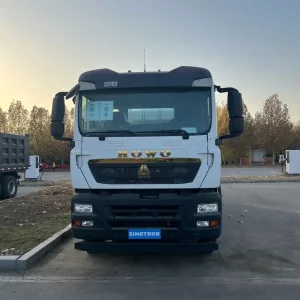
Juxiang’s special truck range provides the correct category path for concrete mixers and other purpose-built vehicles. It is separate from the company’s dump-truck range, which helps buyers keep the vehicle function clear.
The HOWO 6×4 concrete mixer truck is a real product-family entry for evaluation. Buyers should still request the exact chassis, engine, transmission, axle, tyre, drum, mixer drive, water system, discharge accessories and document package offered for their order. The product page supports discovery; the signed technical specification controls procurement.
What Evidence Should Be Requested Before Approval?
Request a quotation-linked configuration sheet, general arrangement or dimensional information as applicable, major-component identification, capacity definitions, included-option list, inspection scope, manuals and delivery-document list. For a sample or first unit, agree the inspection and functional verification plan in advance. Verification should follow supplier and project safety procedures and should not depend on uncontrolled site improvisation.
Use a clarification register with Confirmed, Deviation, Alternative, or Buyer Input Required. Every change should identify the affected configuration, commercial impact and document revision. This gives purchasing, engineering and quality teams the same acceptance basis.
What Common RFQ Gaps Cause Rework?
- Using “concrete dump truck” without defining function: the wrong vehicle family may be quoted.
- Giving only a nominal capacity: volume definitions and operating-mass basis remain unclear.
- Giving only route distance: delay, grade, site speed and cycles are ignored.
- Specifying 6×4 only: major chassis and destination requirements remain open.
- Assuming all webpage options are included: quotations contain different scopes.
- Leaving documents until shipment: registration or acceptance evidence may be incomplete.
What Should a Concrete Mixer Truck RFQ Include?
- Confirmation that the required vehicle is a concrete mixer truck.
- Project application and concrete delivery workflow.
- Required capacity and the definition to be used.
- Batching-plant charging interface.
- Delivery distance, normal/worst cycle time and trips per shift.
- Road type, grade, turning space and site access.
- Destination, public-road requirements and mass constraints.
- Altitude, temperature, dust and seasonal conditions.
- Preferred chassis, axle formula, fuel and emissions requirements.
- Drum, drive, control, chute and discharge requirements.
- Water, wash-down and cleaning scope.
- Safety, inspection and first-unit acceptance requirements.
- Manuals, certificates, parts information and shipping documents.
- Spare-parts and service requirements.
- Quantity, delivery schedule, destination and trade terms.
Submit the completed scope through the special truck quotation request. Require the supplier to correct the vehicle terminology, identify all configuration assumptions and return deviations before the purchase order is approved.